
 · Nativa Dev
This is part 3 of the PHP types for kids series. Previous parts: part 1 ... what's behind a variable and part 2 ... scalar casts. Today we tie it all into one rule that saves CPU in loops. In part 4 we'll then look at arrays,
mixedand DTOs, in part 5 at union types, nullsafe and enums ... and in part 6 at the chunky rule.
A lesson that became a rule
Every project eventually pulls its recurring patterns into rules. One of the lessons that became an official rule in the minimal starter kit (docs(rules) ... commit c519199) reads:
Type strictly and cast data BEFORE iterating ... normalize collections (typed arrays, DTOs, scalar casts) at the boundary, so a loop never has to re-discover the type or behavior of every child node.
In practice: is_*() / instanceof / null-check **once when building the structure, not for every element in a foreach**.
Why it came about
When porting the blog index (/blog), the front matter files brought unguaranteed data shapes. YAML in storage/blog/*.md may have title, or may not; tags may be an array, but could equally be a string or nothing. Two strategies:
- Bad: in the card-rendering loop, check for every article
isset($meta['title']), is_array($meta['tags']), is_scalar($tag) … ... the loop fills up with branches and every child node gets "probed" over and over.
- Good: normalize everything once in the
articles()method,
where front matter enters the system, and from then on work only with typed rows.
Example from the codebase
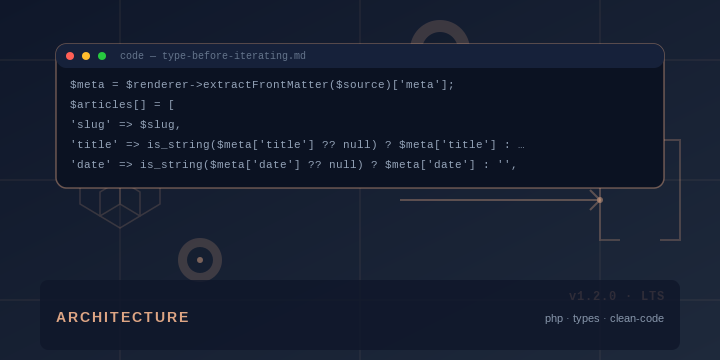
BlogIndexAction::articles() first builds a typed list ... every row has exactly known types (string / list<string>):
$meta = $renderer->extractFrontMatter($source)['meta'];

$articles[] = [
    'slug'     => $slug,
    'title'    => is_string($meta['title'] ?? null) ? $meta['title'] : ucfirst($slug),
    'date'     => is_string($meta['date'] ?? null) ? $meta['date'] : '',
    'excerpt'  => is_string($meta['excerpt'] ?? null) ? $meta['excerpt'] : '',
    'category' => is_string($meta['category'] ?? null) ? $meta['category'] : '',
    'author'   => is_string($meta['author'] ?? null) ? $meta['author'] : '',
    'tags'     => is_array($meta['tags'] ?? null)
        ? array_values(array_filter(array_map(
            static fn (mixed $tag): string => is_scalar($tag) ? (string) $tag : '',
            $meta['tags'],
        ), static fn (string $tag): bool => '' !== $tag))
        : [],
];
Notice the pattern: **?? null + one is_* + fallback** for every field, and an array_map with a (string) cast for the tags ...
everything at the boundary. The output is declared by a docblock:
/**
 * @return list<array{
 *     slug: string, title: string, date: string, excerpt: string,
 *     category: string, author: string, tags: list<string>
 * }>
 */
Then renderCards() → renderCard() iterate **without a single type check** ... the values are already string, so they just need escaping and printing:
private function renderCard(array $article): string
{
    $href = '/blog/' . $article['slug'];
    $metaBits = array_values(array_filter([
        $article['date'],
        $article['category'],
        $article['author'],
    ], static fn (string $bit): bool => '' !== $bit));
    // ... escape and render, no is_* in the loop body
}
What it gives you
| Without normalization | With boundary normalization | |
|---|---|---|
| Type checks | N × M (for every node × every property) | 1× when building the structure |
| Loop readability | branches, fallbacks, deep isset | clean render, only escaping |
| PHPStan level 9 | endless mixed problems | clear shapes in @return |
| Chunky 60-line rule | the loop grows over the limit | methods stay short |
This is exactly the spirit of the starter kit's C-pattern ... explicit and transparent. Type decisions are made in one place, not scattered across the codebase.
How the lesson spreads further
The new convention doesn't just live in people's heads ... it has two layers:
- Project rule ...
.ai-factory/rules/base.md(PHP section), loaded
automatically via /aif-implement
- Skill context ...
.ai-factory/skill-context/aif-implement/SKILL.md
(commit 5df160b), with a link to the source and an example from the codebase, so future AI sessions know it including the reasoning
This is how every recurring pattern turns from a silent experience into an enforced convention ... and the next iteration doesn't start from zero.
Practically
Next time you write a foreach over data that didn't come from your own typed code (YAML, JSON, DB rows, DOM nodes):
- Cast once at the boundary ... when parsing, not inside the loop
- Declare the shape ... a
@returnwith a shape or DTO, so PHPStan
knows what's coming
- Iterate cleanly ... in the loop body just use the values
The loop then answers the question "what to do with it" ... not "what is it, actually".
Sources
- PHP Manual: official PHP documentation
- PHP-FIG, PSR Standards: PHP standards
- Nativa Minimal Documentation: official getting started guide
- OWASP Cheat Sheet Series: security best practices
- W3C, Web Standards: web standards
Comments (0)
No comments yet — be the first to react.