
 · Nativa Dev
Last time we said…
In part 1 we found that **a variable has no type ... a value does**, and PHP juggles types on its own (type juggling). Today we learn to tell PHP exactly what we want, so it doesn't have to guess. Guessing = losing CPU and nerves.
Explicit casts ... throw it into shape
Casting is a deliberate type change ... "I want this value as a string". The syntax is (type) $value:
| Cast | Example | Result |
|---|---|---|
(int) | (int) "42" | 42 |
(int) | (int) "42.9" | 42 ... doesn't round, chops the decimal part |
(int) | (int) "abc" | 0 ... careful, silently! |
(int) | (int) "5abc" | 5 ... reads the start, throws away the rest |
(float) | (float) "3.14" | 3.14 |
(string) | (string) 42 | "42" |
(string) | (string) true | "1" ... bool true becomes "1" |
(bool) | (bool) "false" | true ... careful! Any non-empty string is true |
(bool) | (bool) 0 | false |
(bool) | (bool) "0" | false ... this is the special case |
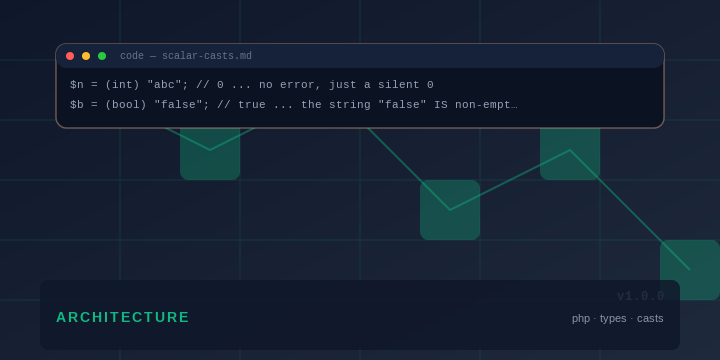
The two biggest traps in the table:
$n = (int) "abc";        // 0 ... no error, just a silent 0
$b = (bool) "false";     // true ... the string "false" IS non-empty, so true!
The string "false" is truthy to PHP, because it's non-empty. The only strings that are false are "" and "0". When you parse a form or JSON and expect a bool, **check the string's content, not its "boolness"**:
// Bad: "false" turns into true
$active = (bool) ($data['active'] ?? false);

// Good: compare the string itself
$active = ($data['active'] ?? '') === 'true' || $data['active'] === true;
Instead of a cast ... functions
Sometimes a function with more precise rules is more readable:
intval("42.9");     // 42
floatval("3.14");   // 3.14
strval(42);         // "42"
boolval(1);         // true
is_numeric("42");   // true ... checks whether it CAN be read as a number
The difference between (int) and intval() is in the detail:intval() also respects notation like intval("0x1A", 16). For everyday work they're equivalent ... pick one style and stick to it.
declare(strict_types = 1) ... don't let PHP dodge
In the starter kit every file has this on the first line:
<?php

declare(strict_types = 1);

function add(int $a, int $b): int
{
    return $a + $b;
}

add(1, 2);     // OK
add("1", 2);   // TypeError! ... the string will no longer silently become an int
Without strict_types, add("1", 2) would silently flip "1" to 1 and continue. With strict_types PHP throws an error ... and that's good! An error forces you to fix it where it originates, not ten calls down the line.
Important:
strict_typesapplies per file ... not globally. The file where the function is called decides (i.e. where the call is written), not where it's defined. That's why it goes at the start of every file.
The cast-at-boundary pattern ... cast at the boundary, not in the loop
And now the part that saves CPU. A boundary = the place where data enters your code: a form, JSON, YAML front matter, a row from the database, an API response. At the boundary the data is "raw" ... it could be anything. In a loop it should already be precisely typed.
// Bad ... the loop guesses at every element (repeats the work N times)
$total = 0;
foreach ($rows as $row) {
    if (is_string($row['price'])) {
        $total += (float) $row['price'];
    } elseif (is_float($row['price'])) {
        $total += $row['price'];
    } elseif (is_int($row['price'])) {
        $total += (float) $row['price'];
    }
}

// Good ... resolve the type ONCE at the boundary, the loop just computes
$prices = array_map(static fn (mixed $p): float => (float) $p, $rows);
$total = array_sum($prices);
In the second case the type decision is made once per row (in array_map), and the loop (array_sum) just sums numbers. With 10,000 rows the difference in the number of type checks is striking ... and the code is also shorter and more readable.
Summary of part 2
(int),(float),(string),(bool)... a deliberate type
change; watch out for (int) "abc" → 0 and (bool) "false" → true
declare(strict_types = 1)... every file, no silent type
flipping in function calls
- Cast-at-boundary ... resolve the type at the boundary (input),
not in the loop; the loop then just works
- For a bool from a form/JSON compare the string, don't cast
blindly
In part 3 we'll tie it all into one rule with a real example from BlogIndexAction ... and show how typed data keeps loops short and methods within the 60-line limit. In part 4 we'll talk about what happens when data isn't scalar ... array vs list, mixed and DTOs. In part 5 we'll look at union types, nullsafe and enums ... and in part 6 at why 60 lines.
Sources
- PHP Manual: official PHP documentation
- PHP-FIG, PSR Standards: PHP standards
- Nativa Minimal Documentation: official getting started guide
- OWASP Cheat Sheet Series: security best practices
- W3C, Web Standards: web standards
Comments (0)
No comments yet — be the first to react.