
 · Nativa Dev
Who this series is for
If you've ever written $x = "5"; and then $x + 1 and **didn't know exactly** what would happen ... this series is for you. We call it "for kids" ... for clear heads, untainted by old habits and patterns. No prejudice, no "that's not how you do it", just a fresh look at why PHP behaves the way it behaves.
The series has six parts:
- This part ... what scalar types are and why PHP "weaves" between
them so easily
- Part 2 ... scalar casts ... how to tell
PHP exactly what you want, and strict_types
- Part 3 ... type strictly and cast before iterating ... how it all saves CPU in loops
- Part 4 ... array vs list, DTO and mixed ... what happens when data isn't scalar
- Part 5 ... union types, nullsafe and enums ... when one value can be several things
- Part 6 ... why 60 lines? (chunky rule) ... one method, one thing
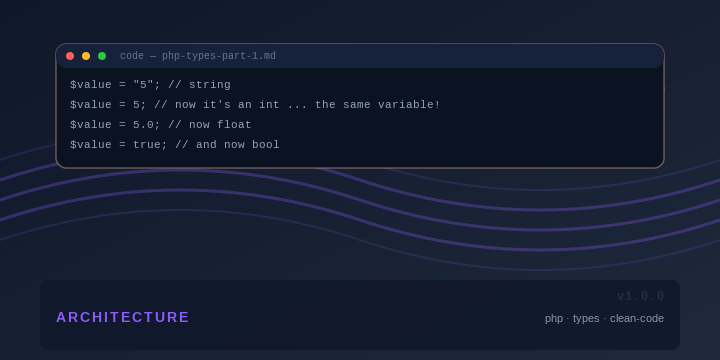
A variable has no type. A value has a type.
This is the most important sentence of the whole series. In PHP:
$value = "5";    // string
$value = 5;      // now it's an int ... the same variable!
$value = 5.0;    // now float
$value = true;   // and now bool
A variable is just a container. The type belongs to the value currently sitting in it. In languages like C or Java you "type" a variable once and that's it ... in PHP the type changes depending on what you assign. That's called dynamic typing, and it's the main source of all the "magical" bugs.
Four scalar types
A scalar type = one simple value. PHP has four of them:
| Type | Examples | In plain words |
|---|---|---|
int | 42, -7, 0 | a whole number |
float | 3.14, -0.5, 2.0 | a decimal number |
string | "hello", '', "5" | a string of characters |
bool | true, false | truth/falsehood |
Plus null (no value) and compound types (array, object) ... we'll leave those for another time. The important thing: "5" is not 5.
One is a string, the other a number. They look the same, they behave differently.
Type juggling ... when PHP "guesses"
Because PHP is lax, when you give it mixed types it **decides on its own how to combine them. That's called type juggling**:
echo "5" + 3;       // 8  ... the string "5" turned into the number 5
echo "5" . 3;       // "53" ... the number 3 turned into the string "3"
echo "abc" + 3;     // 3  + warning ... "abc" can't be read as a number, so 0
echo "5abc" + 3;    // 8  ... PHP reads the 5, throws away the rest (warning since PHP 8)
echo 1 == "1";      // true  ... loose comparison compares values
echo 1 === "1";     // false ... strict comparison checks the type too
Notice the last two lines: == (loose) and === (strict). Loose comparison is a jungle:
var_dump(0 == "a");      // false in PHP 8 (it was true in PHP 7!)
var_dump(0 == "");       // false in PHP 8
var_dump("0" == "");     // false
var_dump("1" == "01");   // true ... both are read as numbers
var_dump("abc" == 0);    // false in PHP 8
PHP 8 fixed a lot of this, but the rule stays: when comparing, always use === and !== unless you really know what you're doing.
Why it costs you CPU
Every type juggling is extra work PHP has to do on every access. And now the best part ... when you have a loop:
// Bad: every iteration re-discovers what $row['count'] actually is
foreach ($rows as $row) {
    if (is_string($row['count']) && is_numeric($row['count'])) {
        $total += (int) $row['count'];
    } elseif (is_int($row['count'])) {
        $total += $row['count'];
    }
}
PHP re-examines the type on every loop pass ... for every row, for every column. With 10,000 rows that's 10,000 times the same decision.
We can avoid that ... and that's exactly what parts 2 and 3 are about.
Summary of part 1
- A variable has no type ... a value does; PHP is dynamically typed
- There are 4 scalar types:
int,float,string,bool "5"is not5... same look, different behavior- PHP juggles types automatically (type juggling) ... sometimes
useful, often a betrayal
- When comparing, use
===/!==, not==/!=
In part 2 we'll show how to tell PHP exactly what you want ... explicit casts and declare(strict_types = 1). In part 3 we'll tie it all into a rule that saves processor cycles. In part 4 we'll look at arrays, mixed and DTOs. In part 5 at union types, nullsafe and enums ... and in part 6 at why methods must not stretch past 60 lines.
Sources
- PHP Manual: official PHP documentation
- PHP-FIG, PSR Standards: PHP standards
- Nativa Minimal Documentation: official getting started guide
- Web.dev, Performance: Core Web Vitals
- Lighthouse Documentation: Lighthouse tool
Comments (0)
No comments yet — be the first to react.