
 · Nativa Dev
This is part 6 of the PHP types for kids series. Previous parts: part 1 ... what's behind a variable, part 2 ... scalar casts, part 3 ... type strictly before iterating, part 4 ... array vs list, DTO and mixed and part 5 ... union types, nullsafe and enums. Today we close it all with the rule that the starter kit enforces with an architecture test.
The rule that won't let you write long methods
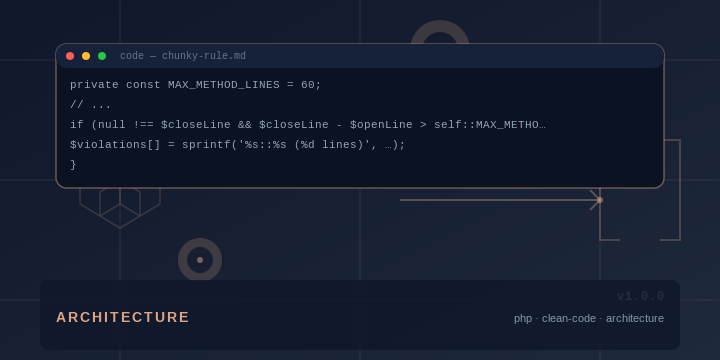
The starter kit has an architecture test (tests/Architecture/CorePatternTest.php) that scans all of src/ looking for methods longer than 60 lines:
private const MAX_METHOD_LINES = 60;

// ...
if (null !== $closeLine && $closeLine - $openLine > self::MAX_METHOD_LINES) {
    $violations[] = sprintf('%s::%s (%d lines)', …);
}
When the test finds a violation, it fails with:
Methods longer than 60 lines are forbidden (chunky: one screen per function):
src/Modules/Core/Interfaces/HTTP/Actions/BlogArticleAction.php::handle (65 lines)
It's not a "recommendation" or a code review note ... it's a **red test you must fix for the build to pass**. And that's exactly the point:
rules that aren't enforced aren't followed.
Why "one screen"
The name says it all ... chunky (from "chunk"): a method should be small enough to fit entirely on one screen. Why this precisely?
When a method outgrows the screen, you stop "seeing it whole". Reading 80 lines requires:
- scrolling up and down
- holding context in your head ("what was on line 10 when I'm on line
70?")
- searching for where things change
And that's exactly what matters most for kids ... clear heads: **a short method with a good name can be understood without reading it all.**
You read the name and you already know what it does.
A real story from the codebase ... what it looks like when you break it
This article has a living example right from this project. While refactoring BlogArticleAction, I added tag normalization at the boundary (part 3!) directly into the handle() method. And what happened? The test failed:
BlogArticleAction.php::handle (65 lines)Exactly 5 lines over the limit. The fix was simple and it's **the same pattern the whole series teaches**: resolve the problem at the boundary and split into named helpers.
Before ... everything crammed into handle() (abbreviated):
public function handle(Request $request): Response
{
    // … slug validation, file reading, front matter …

    $metaBits = array_values(array_filter([ … ]));   // 5 lines of logic
    $tags = is_array($meta['tags'] ?? null)          // tag normalization
        ? array_values(array_filter(array_map(…)))   // …
        : [];
    $tagChips = '';
    if ([] !== $tags) { … }                          // tag rendering
    // … article render …
}
After ... handle() just tells the story, details live in named methods:
public function handle(Request $request): Response
{
    // … slug validation, file reading, front matter …

    $title = is_string($meta['title'] ?? null) ? $meta['title'] : ucfirst($slug);
    $excerpt = is_string($meta['excerpt'] ?? null) ? $meta['excerpt'] : '';

    $metaBits = $this->metaBits($meta);   // what's in the meta line?
    $tagChips = $this->tagChips($meta);   // which tags to render?

    // … article render with $metaBits and $tagChips …
}

/** Date/category/author meta line, non-empty values only. */
private function metaBits(array $meta): array { … }

/** Render tag chips footer ... tags normalized at the boundary. */
private function tagChips(array $meta): string { … }
Notice what happened:
handle()answers "what happens?" ... the story: load → normalize
→ render
- The helpers answer "how?" ...
tagChips()knows how tags are
made
- Names are documentation for free ... you read
$this->tagChips($meta), you don't have to read the body
Why this relates to types (yes, this is a series about types!)
The whole series led to this rule. Look at how the parts connect:
| Part | Lesson | How it keeps methods short |
|---|---|---|
| Part 1 | A variable has no type | Type checks in long methods = chaos |
| Part 2 | Cast-at-boundary | Decide the type once at the boundary → fewer branches in the body |
| Part 3 | Type before iterating | Clean iteration = a short loop |
| Part 4 | Shape/DTO | When a method grows, data wants a DTO, not another branch |
| Part 5 | Union/never | Precise types → fewer defensive checks |
And now the chunky rule: **when a method outgrows 60 lines, it's a symptom** ... not the cause. A symptom that more than one thing is happening in it. And the solution is always the same:
- Normalize at the boundary (parts 2+3) ... resolve raw data early
- Split into named helpers (this part) ... one method = one thing
- If it still grows ... a DTO (part 4) ... the data wants a class
What the limit is NOT
An important note ... 61 lines isn't a "crime". The detector is a smoke test (a warning signal), not a quality meter:
- It's not about the number ... it's about "does it fit on a
screen?"
- It's not dogmatic ... there are legitimate long methods (e.g. a big
match or a SQL builder). The C-pattern handles it elegantly:
match expressions and declarative data can be pulled out into constants/private methods
- It's enforced so there's nothing to discuss ... when a rule is
automatic, you don't have to argue at code review
And one more thing: **handle() is the perfect example of why this works.** When a request arrives at /blog/hello-world, handle() answers "what happens" in ~40 lines ... and every part is named. Kids (and everyone else) read the flow without scrolling.
Practically ... how to practice it
Next time you write a method and feel it growing:
- Count what it does ... if you can say "this does A, B and C" →
that's three methods
- Name those three things ...
normalize(),validate(),render() - Pull the details into helpers ...
handle()tells, helpers do - Let the test guard you ...
composer testwill tell you when it
outgrows
And remember: the limit isn't your enemy. It's a **detector that warns you before you notice yourself** that a method stopped being one thing.
A short method with a good name is respect, respect for the next person who reads it, respect for your future self, respect for the idea that code is read more than it's written.
→ Part 1, what's behind a variable: the foundation → Part 5, union types, nullsafe and enums: precision types → Chunky rule SK: slovenská verzia
Sources
- W3C, ACID Properties: ACID definition
- PHP Manual: official PHP documentation
- SQLite Documentation: SQLite reference manual
- OWASP Cheat Sheet Series: security best practices
- Nativa Minimal Documentation: official getting started guide
Comments (0)
No comments yet — be the first to react.