
 · Nativa Dev
This is part 4 of the PHP types for kids series. Previous parts: part 1 ... what's behind a variable, part 2 ... scalar casts and part 3 ... type strictly before iterating. Today we look at what happens when data isn't scalar ... arrays,
mixedand DTOs. In part 5 then union types, nullsafe and enums ... and in part 6 at why 60 lines.
Last time we said…
In part 3 we normalized front matter **at the boundary** and worked with typed rows from then on. But notice one detail ... the typed row was still an array (array{slug: string, tags: list<string>, …}). Today we'll talk about why "array" isn't "array", what PHPStan level 9 does about it, and when to replace an array with a class.
Not all arrays are the same
PHP has one array type ... but logically there are two kinds:
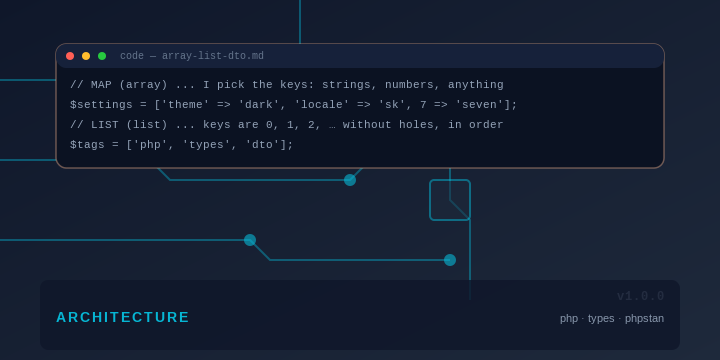
// MAP (array) ... I pick the keys: strings, numbers, anything
$settings = ['theme' => 'dark', 'locale' => 'sk', 7 => 'seven'];

// LIST (list) ... keys are 0, 1, 2, … without holes, in order
$tags = ['php', 'types', 'dto'];array= a general map: keys can be anything, order is my
business.
list= a special case ofarraywhere keys are0..n-1
exactly in order. It's a narrower subset ... every list is an array, but not every array is a list.
Why does it matter? Because with a list you guarantee more ... and PHPStan level 9 can use that.
PHPStan level 9: list is safer
Imagine you want the first tag of an article:
/** @var array<string, list<string>> $article */
$first = $article['tags'][0];  // PHPStan level 9: hmm, could there be a hole?
PHPStan knows $article['tags'] is a list<string> ... and a **list guarantees that index 0 exists**. No hole, no warning.
But when tags arrive as an array with arbitrary keys, PHPStan shakes its head:
/** @var array<string, array<int, string>> $article */
$first = $article['tags'][0];  // PHPStan: array<int, string> may not have key 0!
The difference between array<int, string> and list<string> is exactly this: a list is an "array without holes", so indexing [0], count(), foreach in order ... all safe. An array is a "maybe a map" ... you can't rely on [0].
How a list is born (and how you lose it)
The most common trap: array_filter and array_map preserve keys.
This is how a list becomes an array with holes:
$tags = ['php', '', 'dto'];

// array_filter drops the empty tag, BUT the keys stay: [0 => 'php', 2 => 'dto']
$filtered = array_filter($tags);

var_dump($filtered[1]);  // Undefined array key 1! ... and PHPStan knows it
The solution? array_values() ... reindexes to 0..n-1 and returns a list:
$tags = array_values(array_filter($tags)); // list<string>: [0 => 'php', 1 => 'dto']That's exactly what BlogIndexAction does for the front matter tags ...array_values(array_filter(array_map(…))), to get a guaranteed list<string>:
'tags' => is_array($meta['tags'] ?? null)
    ? array_values(array_filter(array_map(
        static fn (mixed $tag): string => is_scalar($tag) ? (string) $tag : '',
        $meta['tags'],
    ), static fn (string $tag): bool => '' !== $tag))
    : [],
The array_map → array_filter → array_values chain is a pattern you'll see often in the starter kit: **transform → drop empties → reindex to a list**.
mixed ... the type you don't know
And now to mixed. In part 2 we mentioned array_map(static fn (mixed $p): float => …). What actually is that mixed?
mixed = "I don't know what it is". It's the widest type in PHP ...
it accepts anything. It appears everywhere data comes in from outside:
$meta = $renderer->extractFrontMatter($source)['meta'];
// $meta['title'] is mixed ... YAML can contain anything
And here's the key: **PHPStan level 9 treats working with mixed as an error unless you narrow the value** (make it more specific). This is "level 9" in practice:
$title = $meta['title'];              // mixed
echo strtoupper($title);              // PHPStan level 9: cannot call strtoupper() on mixed

$title = is_string($meta['title'])    // narrowing ... now I know it's a string
    ? $meta['title']
    : 'Untitled';
echo strtoupper($title);              // fine
Level 9 forces you to do what we said in part 3: an is_* check once at the boundary, not in a loop. mixed isn't the enemy ... it's an honest "I don't know" that forces you to ask before you do anything with the value.
When a shape array stops being enough ... DTO
A shape array (array{slug: string, tags: list<string>}) is fine for small data. But as a row grows, several problems appear:
- Keys are just strings ... nobody catches a typo in
'titel' - Types live only in a docblock ... refactoring doesn't see them
- No methods ... logic (validation, derived values) has nowhere to
go
The solution: a DTO (Data Transfer Object) ... a small class that holds data and its types together. The starter kit's pattern for it is MenuItemDTO:
final readonly class MenuItemDTO
{
    /**
     * @param list<MenuItemDTO> $children
     */
    public function __construct(
        private string $label,
        private string $href,
        private bool $active = false,
        private array $children = [],
        private bool $external = false,
    ) {
        $this->validate();
    }

    public function label(): string { return $this->label; }
    public function href(): string { return $this->href; }
    public function active(): bool { return $this->active; }
    public function external(): bool { return $this->external; }

    /** @return list<MenuItemDTO> */
    public function children(): array { return $this->children; }

    public function hasChildren(): bool { return [] !== $this->children; }
}
Notice what a DTO adds over a shape array:
- Types are real ...
string $label,bool $active, and above all
list<MenuItemDTO> $children (a list of DTOs, not just any array!)
readonly... the data can't change after creation, which is
exactly what you want from a "transferred object"
- Validation in the constructor ...
validate()throws an exception
at birth, not five uses later
- Methods ...
hasChildren()is more readable than
[] !== $item['children']
DTO vs shape array ... when to use what
| Shape array | DTO | |
|---|---|---|
| Notation | array{slug: string} | a class with typed properties |
| Types | only in a docblock | real, checked by PHP and PHPStan |
| Typo in a key | silent bug | fatal at compile/analysis |
| Validation | nowhere | in the constructor |
| Logic | none | methods (hasChildren()) |
| When to use | small, local data (1–4 fields) | data that travels between layers |
The starter kit's golden rule: **shape arrays for local boundary normalization, DTOs for data crossing module boundaries** (repository → service → action). MenuItemDTO and TranslationDTO are exactly that.
So what does level 9 actually want
PHPStan level 9 is the strictest level ... and the starter kit runs on it with zero errors. In short:
- No operations with
mixed... every value must first be narrowed
(is_string, is_array, …)
- No indexing of
arraywithout a guarantee ...listis safer
than array<int, T>
- No unverified accesses ...
$row['key']onmixedis an error;
resolve it at the boundary
- Casts, not forces ... exactly from part 2
What does it all look like in practice? BlogIndexAction has at the end of articles() a docblock that is the contract between normalization and render:
/**
 * @return list<array{
 *     slug: string, title: string, date: string, excerpt: string,
 *     category: string, author: string, tags: list<string>, image: string
 * }>
 */
list<…> on the outside (articles are ordered, no holes) + list<string> for tags + nothing but string values = the render can be clean, without a single is_* in the loop.
Summary of part 4
arrayvslist... alistis an array without holes
(0..n-1); PHPStan level 9 knows it and [0] on a list is safe
array_filter/array_mappreserve keys ... reindex with
array_values() to get a list
mixed= "I don't know" ... level 9 forces you to narrow
(is_*) at the boundary, not in a loop
- DTO ... when data travels between layers, give it a class
(final readonly + typed properties + validation); leave shape arrays for local data
- The contract in
@return...list<array{…}>is a readable
agreement between normalization and the consumer
With this we went from "a variable has no type" (part 1) through casts and strict_types (part 2) and typing before iterating (part 3) up to arrays, mixed and DTOs. The series continues in part 5 ... union types, nullsafe and enums ... and part 6 closes it with the chunky rule. Clean heads, clean data, clean loops.
Sources
- W3C, ACID Properties: ACID definition
- PHP Manual: official PHP documentation
- SQLite Documentation: SQLite reference manual
- OWASP Cheat Sheet Series: security best practices
- Nativa Minimal Documentation: official getting started guide
Comments (0)
No comments yet — be the first to react.