Index
Blog
Plain Markdown, one module, no build required.
2026-09-13 · Architecture · Evan McDan
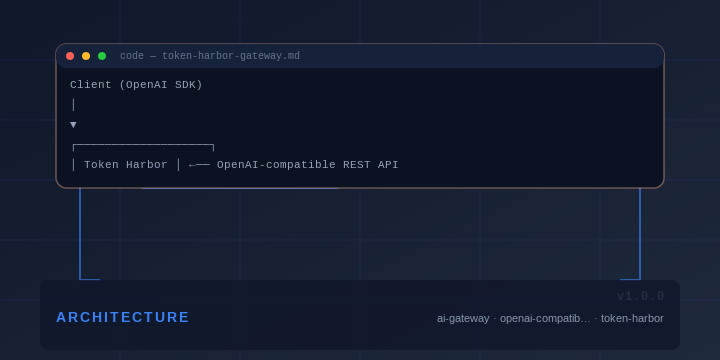
Token Harbor is a unified API endpoint for accessing multiple LLM models (Claude, GPT, Gemini, DeepSeek, Qwen) through one OpenAI-compatible contract. This article covers the architecture, OMP integration, API key security, and production best practices.
Read article →
2026-09-11 · Architecture · Nativa Dev
Part 8 landed the authorization contract. This week brought something new: the first module that admits its imports (comments needs both blog and users), the admin user edit as a command, and issue #63, three state machines and four invariants declared as an attachment, including two honest gaps the model names itself.
Read article →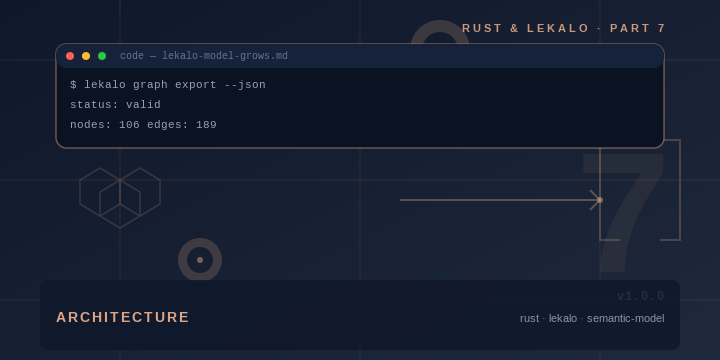
2026-09-08 · Architecture · Nativa Dev
Part 6 ended with a live run on 53 definitions. Yesterday the model doubled to 106 nodes, authorization became a declared contract, the blog module joined the model, and the toolchain became a gate that runs on every push, with honest limits, live output included.
Read article →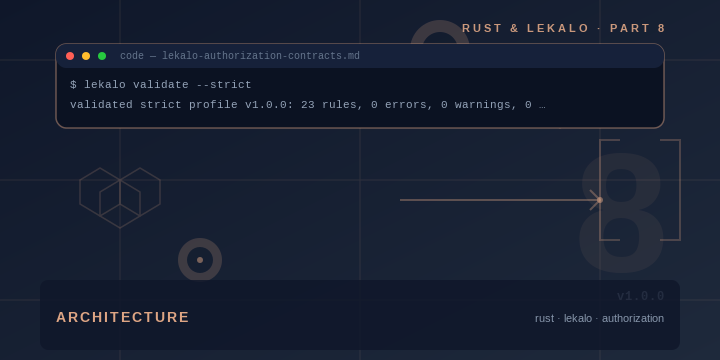
2026-09-08 · Architecture · Nativa Dev
Part 7 ended with one green line: strict review validated clean. This article is about the document that made it possible, lekalo/authorization.yaml: actors, role chains, protected effects, the IR-digest pin, adapter mapping evidence, and what strict review actually checks (and honestly doesn't).
Read article →
2026-09-06 · Architecture · Nativa Dev
A new series. Rust is the language behind Lekalo, the semantic-model tool that analyzes this very PHP project. Part 1 explains what Rust actually is (no GC, no runtime, a compiled binary), why a PHP developer should care, and maps the whole six-part series.
Read article →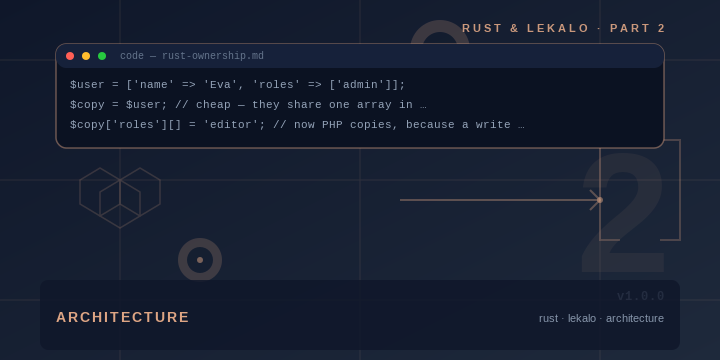
2026-09-06 · Architecture · Nativa Dev
Part 2 of the Rust series. PHP frees memory with a garbage collector; Rust frees it at compile time. The idea that makes that possible is ownership, and it behaves nothing like PHP arrays. We compare copy-on-write with move semantics and look at a real boundary from this repo.
Read article →
2026-09-06 · Architecture · Nativa Dev
Part 3 of the Rust series. Ownership was the mental model; tooling is how you live with it. We dissect the Lekalo CLI, a two-crate cargo workspace, clap parsing, an exit protocol (0/1/3/4/5) and byte-identical canonical output, and why deterministic output is the point.
Read article →
2026-09-06 · Architecture · Nativa Dev
Part 4 of the Rust series. Part 3 promised output you can trust; this part shows how Lekalo keeps that promise honest, five cargo commands that gate every change, a pinned MSRV tested on three operating systems, hermetic fixtures with golden bytes, and Node.js contract checkers validating JSON Schema contracts.
Read article →
2026-09-06 · Architecture · Nativa Dev
Part 5 of the Rust series. Before the Lekalo finale: what a semantic application model actually is. A model is not source code and never parses source code, it's a language-neutral description of entities, commands, policies and endpoints, living in fixed YAML/JSON homes. We use this repo's own lekalo/ directory as the example.
Read article →