
 · Nativa Dev
In part 1 we said Rust has no garbage collector and no runtime, memory is freed at compile time, deterministically. But that claim hides a question: if there's no runtime sweeping memory, then who decides when a value can be freed? The answer is the single most important idea in Rust, and the one that feels most alien to a PHP developer:
**Every value has exactly one owner. When the owner's scope ends, the value is freed.**
That's it. No collector, no sweeper, no "stop the world" pause. Just one rule, enforced by the compiler, that turns memory bugs into compile errors.
This part explains the rule, how it differs from PHP's model, and what it has to do with a method you've probably read in this repository.
PHP: copy-on-write, invisible sharing
PHP arrays are famous for being cheap to copy. That's because PHP doesn't actually copy them, it uses copy-on-write: two variables can point at the same array in memory, and only when one of them writes does PHP duplicate the data.
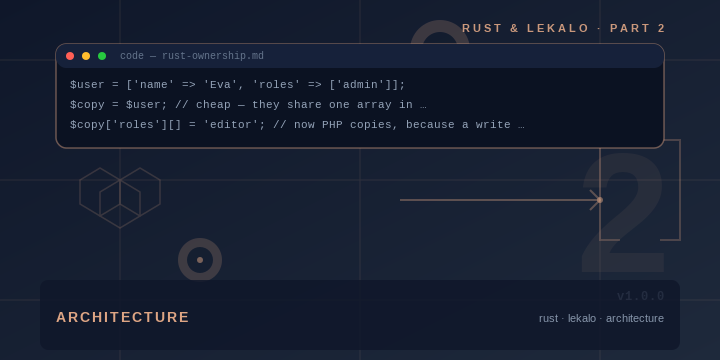
$user = ['name' => 'Eva', 'roles' => ['admin']];
$copy = $user;                  // cheap — they share one array in memory
$copy['roles'][] = 'editor';    // now PHP copies, because a write happens
This is invisible and forgiving. You can pass the same array to five functions and PHP figures out sharing and copying for you. You never think about who "owns" $user: and that's precisely the problem. Rust's position is: if nobody owns it, then when it is freed is somebody else's runtime problem. PHP accepted a runtime (and a collector) to buy that freedom.
Rust: move, not copy
In Rust, assigning a value to another name does not copy it, it moves ownership.
let user = User::new("Eva");
let moved = user;   // ownership of user moves to `moved`
// println!("{user}"); // compile error: use of moved value
After the move, user is gone. The compiler knows it, and using the old name is a compile error, not a crash, not a null, not an undefined value.
A compile error, before the program ever runs. That's the trade: PHP lets you share everything and pays with a runtime; Rust makes ownership explicit and pays with compile-time strictness.
Small values that are cheap to copy (numbers, booleans) implement Copy and still copy on assignment. But anything with real weight, a string, a database row, a request, moves. And if you want to use a value without taking ownership of it, you borrow it.
Borrowing: many readers, one writer
Ownership would be unusable if you couldn't share. So Rust has borrowing:
a reference &T that lets you read a value without owning it.
fn count_roles(user: &User) -> usize { user.roles.len() }

let n = count_roles(&user); // borrow — `user` is still owned and usable
The borrow checker is the part of the compiler that polices these references. Its rules read like a bouncer's: either one writer or many readers, never both at the same time. If you try to hand out a mutable reference while another reference is still alive, the program doesn't compile. Data races, two pieces of code mutating the same memory concurrently, become impossible, because the compiler forbids the pattern that causes them.
This is the "borrow checker" of part 1: the discipline PHP enforces with warnings and discipline (or silently ignores) is enforced in Rust at compile time, for every program, always.
Scope is the free point
Because every value has one owner and the owner's scope ends at the closing brace, memory is freed when the scope ends: the pattern is called RAII (resource acquisition is initialization), and it extends beyond memory.
Files, locks, database connections: whatever you acquire, you release by dropping the value. No finally blocks, no unset(), no forgetting.
{
    let handle = File::open("app.log")?; // acquired here
    // ... work with handle ...
} // handle is closed and freed here, automatically
Compare that with PHP, where you close a file with fclose(), release a lock with unlock(), and hope you remembered. Rust's answer: the scope is the cleanup.
A boundary from this repo: User::fromRow()
Here's the connection to code you can open right now. In src/Modules/Users/Domain/Entities/User.php, the entity is created from a raw database row:
public static function fromRow(array $row): self
{
    return new self($row);
}
Look at what the constructor does with that raw row: it normalizes is_active into a real boolean once, and last_login_at into a nullable string once. The comment in the code says it best: *"Normalized once at the boundary, no re-guessing per call."*
This is ownership thinking, in PHP clothing. The raw row **crosses a boundary** (the database → the domain), and at that boundary it is consumed and converted into a typed, owned object. After that, the row's raw shape is nobody's business, the entity owns its state and no longer re-derives it. Every caller gets a consistent, normalized User instead of guessing what $row['is_active'] might have been.
In Rust, that same boundary would be explicit in the type system: a function that consumes a row and returns an entity,
fn from_row(row: Row) -> User { /* row is moved in, consumed, gone */ }That makes it impossible to use the row afterwards, by construction. The normalization happens once because the row physically cannot be read twice.
The principle is the same in both languages: **normalize at the boundary, then own the result.** Rust just has a compiler that enforces the "once".
What ownership buys you
- No use-after-free: the compiler knows a value's lifetime and refuses
code that touches freed memory.
- No double-free: one owner means one free, by construction.
- No data races: the borrow checker's one-writer rule is checked at
compile time.
- Deterministic cleanup: scope is the free point; no GC pauses.
PHP doesn't have these bugs because the runtime prevents them, at the cost of a runtime. Rust doesn't have them because the compiler prevents them, at the cost of learning to think in owners and borrows. Part 1's claim was that this makes Rust the right tool for long-running, safety-critical tooling.
Lekalo, the tool at the end of this series, leans on exactly these guarantees: a CLI that parses models, builds graphs, and must never corrupt memory while doing it.
What's next
Ownership is the mental model; tooling is how you live with it day-to-day. Part 3 looks at cargo workspaces, CLIs, and one thing Rust does better than almost anything else: deterministic, byte-identical output, which is exactly what makes Lekalo's graph export reproducible:
Sources
- The Rust Book, Understanding Ownership: ownership, borrowing, move semantics
- The Rust Book, Smart Pointers: RAII and ownership of resources
- PHP Manual, Arrays: copy-on-write background
Comments (0)
No comments yet — be the first to react.