
 · Nativa Dev
Part 6 ended with a live run: 53 definitions, 23 rules, zero errors. The model worked. Yesterday the model grew up, and the toolchain stopped being optional. One commit at a time, three things happened: the CLI moved to 0.1.30, authorization became a declared contract instead of an assumption, and the Blog module joined the model. Then the whole thing became a CI gate that runs on every push.
Every number below is live output from this repository, run today.
1. The graph nearly doubled
In part 6 the whole model was one module, Users, and the dependency graph reported 55 nodes, 106 edges. Yesterday we added the Blog module. The graph now reports:
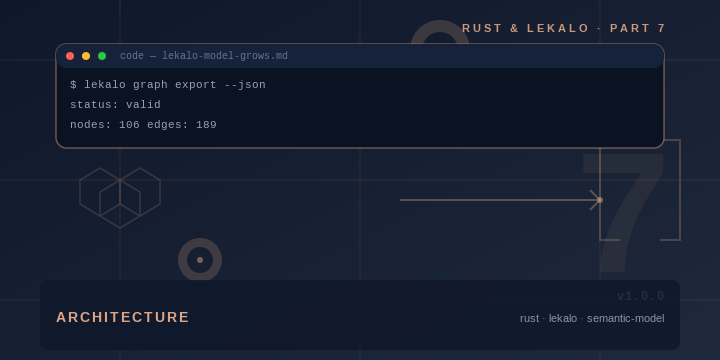
$ lekalo graph export --json
status: valid
nodes: 106 edges: 189
Almost double the nodes, 78 more edges, because the blog surface is surprisingly large: six read queries (index, by-slug, full-text search, tags, categories, series), four admin commands with four declared effects and two events, ten endpoints, four scenarios and a policy (blog.cover_owned_by_article) that keeps covers bound to their article.
All of it declared, none of it executed. Lekalo stays pure declaration, the PHP runtime remains hand-written.
2. Authorization became a contract (#25)
The biggest change wasn't a new module, it was a new document at the project root: lekalo/authorization.yaml. It declares who is allowed to do what, in the model's own vocabulary:
schema_version: "lekalo/authorization/v1.0.0"
roles:
  - id: users.role.guest
  - id: users.role.member
    implies: ["users.role.guest"]
  - id: users.role.admin
    implies: ["users.role.member"]
policies:
  - id: users.policy.public_auth_flow
    actor: public
    decision: allow
    error_ref: "users.error.unauthorized"
    applies_to: ["users.register", "users.login", "users.request_password_reset", "users.reset_password"]
  - id: users.policy.admin_role_management
    actor: identity.user
    decision: allow
    error_ref: "users.error.forbidden"
    applies_to: ["users.create_role", "users.delete_role", "users.sync_role_permissions", "users.list_roles"]
    roles: ["users.role.admin"]
Three actors (public, identity.user, internal), a role chain that mirrors the kit's RBAC (guest -> member -> admin, with admin implying member implying guest), and four policies covering every Users command and query. Domain rules that are not authorization, password length, unique email, inactive account, deliberately stay model-level policies, because authorization and domain logic are different contracts.
The honest footnote: authorization here is **declaration and validation, not enforcement**. Lekalo proves the policies are well-formed and the symbols they reference exist; it never runs them. The runtime RBAC is still hand-written PHP, the model and the runtime agree because both are kept honest, not because one generates the other.
3. The blog module: read-side gates in a command-only grammar
Modeling the blog exposed a real limitation of the current schema. The Model 1.0.0 policy grammar accepts commands only, but two of the blog's most important gates are read-side: the members-only gate on article viewing, and translation parity between sk/ and en/ directories. The workaround is honest and documented: those read-side gates live in lekalo/modules/blog/policies.yaml with a comment explaining why they can't be first-class authorization policies yet.
The rest of the module is textbook. The article entity's identity is slug + locale: the same pair that actually addresses an article on disk (storage/blog/{sk,en}/{slug}.md):
$ lekalo inspect blog.article_by_slug
symbol: blog.article_by_slug
kind: query
module: blog
contract:
  reads: blog.article
  returns: blog.article?
effects: state=available
  - read operation:blog.article_by_slug -> blog.article (canonical)
dependents: state=available
  - exposes blog.endpoint_article (canonical)
  - exposes blog.endpoint_cover (canonical)
One query, projected: what it reads, what it returns, who exposes it. And the scenarios tie it together end-to-end,read_flow, search_flow, members_gate_flow, admin_editing_flow: so the model covers the lifecycle, not just the symbols.
4. Gates: the model became mandatory
The most important commit yesterday wasn't a feature, it was the lock.
$ lekalo lock --check
lock checked sha256:d6550607… resolver 1.0.0 (adapters 0, generators 0, profiles 0, capabilities 0)
The re-lock from 0.1.26 to 0.1.30 changed exactly two fields in the lockfile,core.version and resolver.request_digest: because the contract digests moved upstream. Resolution itself is unchanged. And now the lock isn't documentation, it's a gate:
make lekalo-check:lock --check+validate: is wired into
pre-commit and runs on every push in CI.
- The CI job installs the CLI at the pinned
v0.1.30tag, so the gate
never silently shifts under you.
docs/lekalo-model.mddocuments the layout, the re-lock workflow and
the version policy, so the next model change doesn't have to be reverse- engineered.
$ lekalo validate --project .
validated default profile v1.0.0: 23 rules, 0 errors, 0 warnings, 0 info
Honest limits (as of 0.1.30)
Yesterday's work also drew the boundary of what's not there yet, on purpose:
lekalo inspectcan't project authorization policies yet. The
policies validate, but inspect users.policy.public_auth_flow answers inspect.symbol-unknown. The authorization document is validated, not yet individually inspectable.
validate --strictpassed by the time you read this. The first
run after the blog module refused with `LEK-AUTH-009 authorization.effect-unprotected`, the blog effects had no authorization declarations. The follow-up was small: two new policies (blog.policy.public_read for the six queries plus record_view, blog.policy.admin_editing for CRUD under users.role.admin), a refreshed model_ref pin, and full mapping evidence for the php-nativa target. Strict now validates clean, `23 rules, 0 errors, 0 warnings, 0 info`.
- Upstream surfaces are still deferred: error contracts (#62), the
users.error.* vocabulary is pinned via error_refs but has no per-project declaration surface yet; extended effects (#26), the intended event semantics (local delivery, unordered, no dedup, standard sensitivity, portable) are documented but have no canonical home; strict review waits for adapter mapping evidence (#27–#29); the AIFHub provider protocol is unpublished.
These aren't failures. They're the model telling the truth about where the project stands, which is exactly what the tool is for.
The deeper shift yesterday wasn't the node count. It was that the model stopped being something we look at and became something that checks, on every push, in CI, before anything ships. A reviewer can miss a file; a gate cannot. The model is a second pair of eyes that never sleeps, and yesterday we gave it a badge and a schedule.
→ Part 6, Lekalo deep dive: where the series went live on the Users model → Part 5, semantic application models: why the model layer exists at all → The model documentation on GitHub: layout, re-lock workflow, version policy
Sources
- Lekalo: project repository (product 0.1.30)
- docs/lekalo-model.md: this repository's semantic-model documentation
lekalo/authorization.yaml: authorization contract (#25), role chain and policieslekalo/modules/blog/*.yaml: the Blog module's semantic model
Comments (0)
No comments yet — be the first to react.