
 · Nativa Dev
This is part 6 ... the final part of the Clean code for kids series. Previous parts: 1 ... what is clean code, 2 ... names are documentation, 3 ... one thing (SRP), 4 ... DRY vs premature abstraction and 5 ... smoke tests. All the rules we learned live inside one file or one class. Today we take a step back and look at a bigger scale: the boundaries between modules. Because clean code doesn't end at a method ... it ends at who can talk to whom.
The apartment block: every flat has its own pipes
Imagine an apartment block. Every flat has its own pipes, its own electricity, its own walls. When your bathroom leaks, you don't break into the neighbor's bathroom ... you call your plumber and they fix your flat. The neighbor doesn't help by running pipes through your living room.
Modules in code are flats in an apartment block. Every module (e.g.Users, Settings, Locales) has its own layers ... and those layers have precisely defined what they may do. Boundaries aren't bureaucracy.
They're points where the world changes: when you replace the pipes in one flat, the other flats shouldn't feel it.
Three layers of a module: what each does
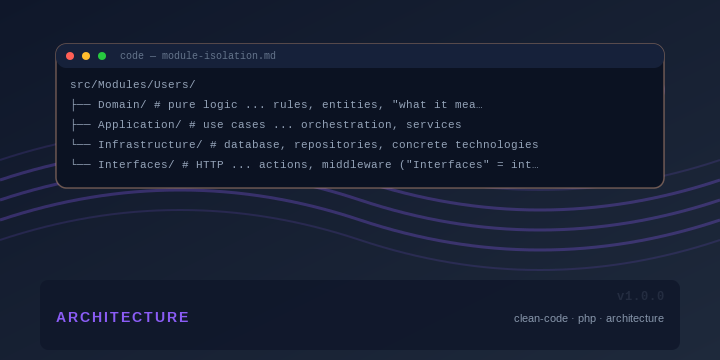
Every feature module in this repo has three layers. Look at Users:
src/Modules/Users/
├── Domain/          # pure logic ... rules, entities, "what it means to be a user"
├── Application/     # use cases ... orchestration, services
└── Infrastructure/  # database, repositories, concrete technologies
    └── Interfaces/  # HTTP ... actions, middleware ("Interfaces" = interface with the world)
And now the most important thing ... which layer may import what:
| Layer | What it may use | What it must NOT |
|---|---|---|
Domain | only itself (pure PHP, no imports) | Infrastructure and Interfaces ... its own or others' |
Application | its own Domain + the shared kernel (Core + Database) | other modules' Infrastructure/Interfaces |
Infrastructure/Interfaces | anything (it's the module's "outside world") | ... |
Notice the first row. Domain imports nothing at all. That's the strictest rule ... and the most important.
Real example: the User entity doesn't know about the database
Look at the User entity in src/Modules/Users/Domain/Entities/ ... the whole file, including the header:
<?php

declare(strict_types = 1);

namespace Modules\Users\Domain\Entities;

/**
 * User domain entity.
 */
final class User
{
    /** @var list<string> role names */
    private array $roles = [];

    // …

    public function __construct(private array $data)
    {
        $active = $data['is_active'] ?? 1;
        $this->isActive = 1 === (is_numeric($active) ? (int) $active : 0);
    }
}
Notice what's missing: no use statement. No DatabaseConnectionManager, no PDO, no SQL. User receives a plain array and can turn it into its logic. How does it know it's active?
From the array, not from the database.
Why is this good? **Because user logic doesn't change when the storage changes.** Whether the data is in SQLite, a JSON file or the cloud ...
the rule "a user is active when is_active is 1" stays the same. If User knew the database, every storage change would force you to touch the logic. A boundary = a point where the world changes ... and we put it exactly where it belongs.
So where does the database live? In the Infrastructure layer ... in UserRepository:
// src/Modules/Users/Infrastructure/Persistence/Repositories/UserRepository.php
final class UserRepository
{
    public function __construct(private readonly PDO $pdo)
    {
    }
    // SELECT * FROM users WHERE … → new User($row)
}
UserRepository knows about PDO and SQL. User knows about nothing.
Two classes, two worlds ... and between them exactly one boundary.
How the test guards boundaries
Of course, this repo enforces it with a test ... we learned that in part 5. The test is called ModuleIsolationTest and does exactly what an inspector in the apartment block would do: it walks all the modules and looks at every use statement.
// tests/Architecture/ModuleIsolationTest.php ... simplified
foreach ($files as $file) {
    // The check only concerns Domain and Application layers
    $isDomainOrApp = str_contains($relativePath, '/Domain/')
        || str_contains($relativePath, '/Application/');
    if (!$isDomainOrApp) {
        continue;
    }

    foreach ($lines as $line) {
        if (preg_match('/use\s+(Modules\\\\(.+)\\\\(Infrastructure|Interfaces))/', $line, $matches)) {
            $importedModule = explode('\\', $matches[1])[1] ?? '';

            // Application may use the shared kernel (Core + Database)…
            if (('Core' === $importedModule || 'Database' === $importedModule) && !$isDomainLayer) {
                continue;
            }

            // …but never another module, and Domain never anything from Infrastructure
            if ($importedModule !== $moduleName) {
                $violations[] = …;
            }
        }
    }
}
Let's break it down:
- It scans only Domain and Application ... Infrastructure and
Interfaces are the module's "outside world", it may import what it needs. The check is exactly where the boundary hurts.
- **The regex looks for
use Modules\…\Infrastructureand
…\Interfaces** ... not just any import. The point isn't "a module must not know another module" (that would be unrealistic), but "a module must not reach inside another module".
- Core and Database are the exception for Application ... that's the
shared kernel, the starter kit's "libc". Every module may use AppPaths, DatabaseConnectionManager, FrontendLayout…
- Domain has no exception ...
$isDomainLayerswitches off even
Core/Database. Domain is strictly pure. Full stop.
And when the test finds a violation, it says exactly who and how:
Module "Locales" violates DDD boundaries by importing
Modules\Cardboard\Interfaces in Application/Services/SomeService.php
A message you can't mishear: "module X reached inside module Y in this class". The fix is always the same ... move the dependency where it belongs, or resolve it through the shared kernel.
Why Core is "libc"
Let's get back to "Core + Database are the shared kernel". What does that mean in practice? Look at BlogArticlesService from the previous parts ... it's in src/Modules/Core/Application/Services/ and imports:
use Modules\Core\Infrastructure\Paths\AppPaths;
use Modules\Core\Infrastructure\Storage\LocalStorageProvider;
use Modules\Core\Interfaces\HTTP\FrontendLayout;
All three imports are from its own module, Core. That's allowed ... a module can use itself. But BlogArticlesService is also used by other parts of the project: BlogIndexAction, AuthorProfileAction… And they don't need any special permission to use it, because **Core is the common language of the whole application** ... like the standard library in C (hence "libc").
AppPaths (file paths), DatabaseConnectionManager (database connections), FrontendLayout (HTML layout) ... these are things every module needs. If each module did them its own way, we'd have seven different ways of finding a file path ... and that's exactly what we fought against in part 4. The shared kernel is the one source of truth for cross-cutting concerns.
Why a test, not trust
And now the question we asked in every part: why enforce it with a test? Because boundaries are silent. When someone in Application of Locales imports Cardboard\Interfaces to save three lines ... the code keeps running, the tests pass, nobody notices anything. Only six months later, when Cardboard changes its internals, Locales breaks ... a foreign module that has nothing to do with it.
A module is a flat: its pipes should be fixed by its plumber. When a neighbor taps into someone else's pipes, nothing leaks today ... but it bursts tomorrow, in a flat that knows nothing about it. The test is insurance that it won't happen: boundaries aren't a recommendation, they're a red test (part 5).
Map of the whole series
And with that we're at the end. Let's put the whole series into one table ... six principles, six measures, six tests that enforce them:
| Part | Principle | Measure | Test that enforces it |
|---|---|---|---|
| 1 | Code is read more than written; story over detail | all of src/ | CorePatternTest |
| 2 | Names are documentation for free | names of methods, variables, classes | readability (chunky test) |
| 3 | One method, one class ... one thing | reason to change | chunky rule + handle() |
| 4 | DRY = one place of truth, no interfaces in reserve | number of copies, implementations | no-speculative-interface, baseline 0 |
| 5 | Rules enforced by a test = smoke tests | tokens, not text | detectors in CorePatternTest |
| 6 | Who can talk to whom | imports between modules | ModuleIsolationTest |
Notice how the measure grows: parts 1–2 talked about lines and names, parts 3–4 about methods and classes, part 5 about the tests that guard it all, and part 6 about the boundaries between modules. Clean code is layered: it starts at a single line and ends at how whole modules talk to each other.
And if you also read the types series, you'll recognize the same across both: there we typed data, here we shape code. Both series meet at one point ... **everything can be enforced by a test**, and when a rule is automatic, you don't have to discuss it.
Series conclusion
Six parts, six principles, one philosophy:
- Code is read ten times more often than it's written ... you write
it for the reader, not for the compiler (part 1).
- Names are documentation for free ... a good name frees you from
reading the body (part 2).
- One thing in one place ... method, class, module: every measure
has one reason to change (part 3).
- DRY yes, premature abstraction no ... one place of truth,
interfaces only when the second implementation arrives (part 4).
- A rule without a test isn't followed ... detectors guard the rules
for you, token by token (part 5).
- Boundaries are points where the world changes ... Domain doesn't
know about the database, modules don't reach into each other's pipes (part 6).
And the most important thing at the end: **clean code isn't aesthetics.
It's respect for the reader.** Every name, every boundary, every test in this repo exists for one person ... for the one who comes after you in six months and tries to understand what you meant. Clean heads, clean data, clean boundaries.
→ Smoke tests: rules enforced by a test = warning smoke signals → DRY vs abstraction: one source of truth → Clean code for kids: respect for the reader
Sources
- PHP Manual: official PHP documentation
- PHP-FIG, PSR Standards: PHP standards
- OWASP Cheat Sheet Series: security best practices
- Nativa Minimal Documentation: official getting started guide
- W3C, Web Standards: web standards
Comments (0)
No comments yet — be the first to react.