
 · Evan McDan
Why compare
Agent frameworks are growing exponentially. Each promises the "best way" to build agents. But each has a different philosophy.
We'll compare5 mainstream frameworks:
| Framework | Philosophy | Core |
|---|---|---|
| DeepSeek Harness | Everything is a plugin | Cordis (TypeScript) |
| LangChain | Chain of thought | Python, LCEL |
| AutoGen | Multi-agent conversation | Python, Microsoft |
| CrewAI | Role-based agents | Python, LangChain |
| OpenAI Swarm | Lightweight handoffs | Python, stateless |
DeepSeek Harness
Philosophy: "Everything is a plugin."
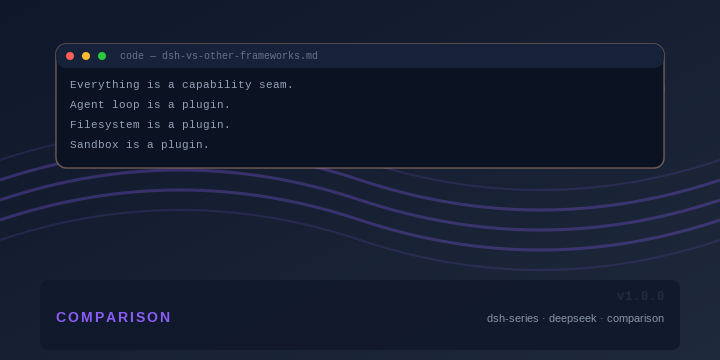
Everything is a capability seam.
Agent loop is a plugin.
Filesystem is a plugin.
Sandbox is a plugin.
Pros:
- 50 packages, each replaceable
- Capability seams (Definition / Provider / Consumer)
- Event-sourced sessions
- Sandbox (bwrap/Landlock/Seatbelt)
- TypeScript (type safety)
Cons:
- Developer preview (still evolving)
- TypeScript only (not Python)
- No community (yet)
When to use: When you need full control over agent architecture and have a TypeScript team.
LangChain
Philosophy: "Chain everything."
Prompt → LLM → Parser → Tool → Memory → Output
Every step is a "chain" or "runnable"
Pros:
- Huge community
- Many integrations (100+ tools)
- LangGraph for state machines
- LangSmith for monitoring
Cons:
- Abstraction overload (too many layers)
- Python only
- High latency (many intermediate steps)
- Hard to debug
When to use: When you need to quickly integrate many external services and have a Python team.
AutoGen (Microsoft)
Philosophy: "Agents talk to each other."
Agent A ←→ Agent B ←→ Agent C
Every agent is "conversational"
Conversation is the main mechanism
Pros:
- Multi-agent conversations
- Group chat between agents
- Code execution in sandbox
- Microsoft backing
Cons:
- Conversational paradigm is limiting
- Hard to control flow
- Python only
- No capability seams
When to use: When you need multi-agent discussions and have a Microsoft ecosystem.
CrewAI
Philosophy: "Role-based agents."
Captain → Researcher → Writer → Reviewer
Every agent has "role", "goal", "backstory"
Pros:
- Simple API
- Role-based design (intuitive)
- Built-in delegation
- Task-based workflow
Cons:
- Depends on LangChain
- Limited flexibility
- No capability seams
- Python only
When to use: When you need a simple multi-agent workflow without complex configuration.
OpenAI Swarm
Philosophy: "Lightweight handoffs."
Agent A → handoff → Agent B → handoff → Agent C
No persistent state
No tools (only handoff)
Pros:
- Ultra-light (~100 lines)
- Simple handoffs
- Stateless (easy to test)
Cons:
- No persistent sessions
- No tools
- No sandbox
- No capability seams
When to use: When you need a simple orchestrator for multi-agent routing.
Comparison
| Aspect | DSH | LangChain | AutoGen | CrewAI | Swarm |
|---|---|---|---|---|---|
| Core | Plugin | Chain | Conversation | Role | Handoff |
| Sessions | Event-sourced | Memory | State | State | Stateless |
| Tools | Scoped | Global | Global | Global | None |
| Sandbox | bwrap/Landlock | None | Code exec | None | None |
| Capability seams | Yes | No | No | No | No |
| Hot-swap | Yes | No | No | No | No |
| Language | TypeScript | Python | Python | Python | Python |
| Maturity | Preview | Stable | Stable | Stable | Experimental |
Key difference: Capability Seams
Only DSH has capability seams. Other frameworks have:
| Framework | Instead of seams |
|---|---|
| LangChain | Tool registry (global) |
| AutoGen | Registered functions |
| CrewAI | Tool descriptions |
| Swarm | None |
Capability seams enable:
- Swapping implementation without changing the consumer
- Scoping (each agent its own tools)
- Composition (sandbox + policy + provider)
- Testing (mock provider)
Key difference: Event-sourced sessions
Only DSH and AutoGen have persistent sessions. But:
| Framework | Session type |
|---|---|
| DSH | Event-sourced (append-only log) |
| LangChain | Memory (state-based) |
| AutoGen | State (in-memory) |
| CrewAI | State (in-memory) |
| Swarm | Stateless |
Event-sourced sessions enable:
- History replay
- Compaction (log shrinking)
- Replication (P2P sync)
- Audit trail
When to use what
| Need | Framework |
|---|---|
| Full control over architecture | DSH |
| Quick integration of 100+ services | LangChain |
| Multi-agent discussions | AutoGen |
| Simple role-based workflow | CrewAI |
| Lightweight orchestrator | Swarm |
| P2P distributed agents | DSH |
| Enterprise with sandbox | DSH |
| Prototype in an hour | CrewAI or Swarm |
Conclusion
There is no "best" framework. Each solves a different problem:
- DSH = full control, modularity, security
- LangChain = integrations, community, development speed
- AutoGen = multi-agent conversations
- CrewAI = intuitive role-based agents
- Swarm = lightness, simplicity
If you're building a production-grade, secure, distributed system → DSH.
If you're building a prototype with many integrations → LangChain.
If you're building a multi-agent discussion → AutoGen.
→ DeepSeek Harness ... 50 packages: architecture overview → Capability seams: the key differentiator → Cordis ... a deep dive: plugin framework → DSH and P2P: distributed agents
Sources
- DeepSeek Harness: open-source agent framework
- LangChain: Python framework
- AutoGen: Microsoft multi-agent
- CrewAI: role-based agents
- OpenAI Swarm: lightweight orchestrator
Comments (0)
No comments yet — be the first to react.