
 · Evan McDan
What is Cordis
Cordis is a TypeScript plugin framework ... not an abstract idea, but a concrete tool with ~2700 lines of code. DeepSeek Harness vendored it into the @deepseek-ai/* scope and added their own patches.
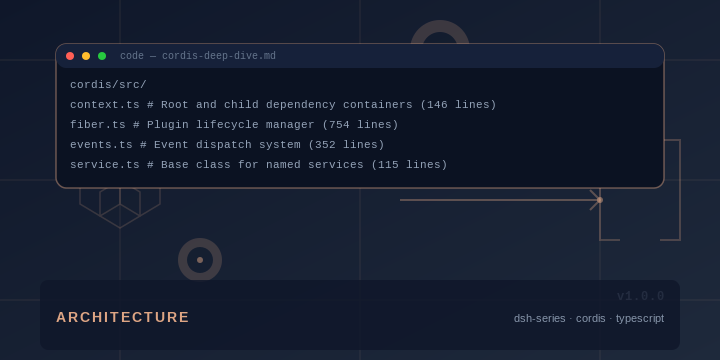
The core has 9 files:
cordis/src/
  context.ts    # Root and child dependency containers (146 lines)
  fiber.ts      # Plugin lifecycle manager (754 lines)
  events.ts     # Event dispatch system (352 lines)
  service.ts    # Base class for named services (115 lines)
  registry.ts   # Plugin registration (337 lines)
  reflect.ts    # Service resolution via proxy (418 lines)
  logger.ts     # Named loggers (270 lines)
  utils.ts      # Shared utilities (287 lines)
  index.ts      # Public API (14 lines)
Context ... the root container
Context is a proxy. Normal property reads go through the service resolver. When you write ctx.logger, Cordis finds the LoggerService and returns it.
// Context is the root dependency container
const root = new Context()

// Plugin registered, ctx now has new services
await root.plugin(MyPlugin)

// Reading through proxy ... finds the registered service
console.log(ctx.myService)  // ← resolves via ReflectService
Scoped contexts
extend(), isolate(), and intercept() create child contexts without mutating the parent:
// Child context with extra metadata
const child = root.extend({ locale: 'sk' })

// Isolated scope for a specific service
const isolated = root.isolate('database')

// Intercept config for plugins under this context
const intercepted = root.intercept('llm', { model: 'deepseek-chat' })
Every child inherits everything from the parent, but own properties shadow the inherited ones. The parent is not mutated.
Fiber ... the plugin lifecycle
Fiber is the lifecycle manager for every plugin. It's 754 lines of code that handle:
State machine
PENDING → LOADING → ACTIVE → UNLOADING → (disposal)
   ↑         ↓          ↓
└─────────┴──────────┘ (reentrant restart)- PENDING ... plugin waiting for dependencies
- LOADING ... plugin is loading
- ACTIVE ... plugin is running
- UNLOADING ... plugin is uninstalling, disposal in progress
Effects ... cleaning up resources
Every plugin can register effects ... pieces of code that run during uninstallation:
// Plugin registering an effect
ctx.effect(() => {
    const db = new DatabaseConnection()

    // Returns a disposer ... runs on UNLOADING
    return () => {
        db.close()  // ← cleanup
    }
})

// Or via generator
ctx.effect(function* () {
    const server = startServer()
    yield () => server.stop()  // ← cleanup
})
Effects run in reverse registration order (LIFO) ... last registered, first released.
DeepSeek patches to fiber
DeepSeek added three key hardenings:
- Reentrant disposal gaps ... an effect's owner-list wrapper is registered BEFORE its setup body, so an unload started from setup awaits setup completion
- Cleanup-time registration rejection ... effect creation is rejected during UNLOADING
- Teardown-notification failure isolation ... one callback cannot interrupt peers
Events ... small-talk between plugins
Cordis has 5 dispatch strategies:
| Strategy | What it does | When to use |
|---|---|---|
emit | Synchronous, ignores return values | Fire-and-forget notifications |
parallel | Awaits all listeners concurrently | Independent parallel operations |
serial | Awaits in order until one bails | Chaining dependent operations |
bail | Synchronous, stops on first bail value | Guard chains (permission checks) |
waterfall | Each listener wraps next() | Middleware chains |
// emit ... fire-and-forget
ctx.emit('p2p/chunk-received', { chunk_id: 'abc' })

// parallel ... all at once
await ctx.parallel('data/processed', result)

// bail ... guard chain
const allowed = ctx.bail('auth/check', { user, action })
if (!allowed) return  // ← someone denied

// waterfall ... middleware chain
const html = await ctx.waterfall('render/page', content)
Service ... named API on ctx
Service is an abstract class for services registered on ctx:
class DatabaseService extends Service {
    // automatic registration as 'database'
    static provide = 'database'

    constructor(ctx: Context) {
        super(ctx, 'database')
    }

    // Callable service ... ctx.database() works as a function
    [Service.invoke]() {
        return this.query.bind(this)
    }
}
Scoped services
Every plugin has its own scoped services ... resources that live only during the plugin's lifetime:
// Plugin A has its own DB
await root.plugin(PluginA)  // ctx.database = PluginA's DB

// Plugin B has its own DB (isolated)
await root.isolate('database').plugin(PluginB)  // ctx.database = PluginB's DB

// When Plugin A is uninstalled, its DB is automatically released
No memory leaks. No orphan connections. Cordis takes care of it.
Intercept config ... configuration through context
intercept() allows changing service configurations for plugins under a given context:
// Set model for all plugins under this context
const withModel = root.intercept('llm', { model: 'deepseek-chat' })

// Plugin A sees model: 'deepseek-chat'
await withModel.plugin(PluginA)

// Plugin B sees model: 'gpt-4' (no intercept)
await root.plugin(PluginB)
Config is merged from ancestor entries ... the closer to root, the earlier it applies.
How DeepSeek Harness uses Cordis
| Need | Cordis mechanism |
|---|---|
| Plugin lifecycle | Fiber (PENDING→LOADING→ACTIVE→UNLOADING) |
| Resource cleanup | Effects (LIFO disposal) |
| Inter-plugin communication | Events (5 dispatch strategies) |
| Scoped isolation | Context (extend/isolate/intercept) |
| Named services | Service class (auto-registration) |
| Config management | Intercept config (ancestor merge) |
→ DeepSeek Harness and Cordis: the plugin framework for tomorrow → DeepSeek Harness ... 50 packages: architecture overview → ACID for beginners: why transactions aren't boring
Sources
- Cordis: TypeScript plugin framework
- DeepSeek Harness: agent framework built on Cordis
Comments (0)
No comments yet — be the first to react.