
 · Nativa Dev
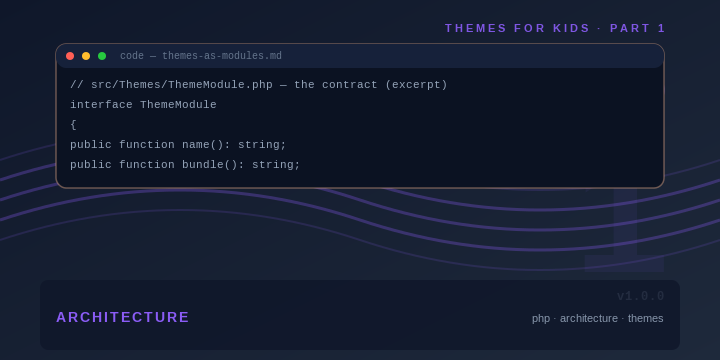
Auto-discovery and a registry was one answer, the theme comparison another viewpoint. This series starts where both ended ... a theme as a module. Part 1: the contract, the connector and a boundary guarded by a test.
You are a PHP developer. You add a new page to the blog, say, a monthly archive. You open the action, add rendering, reach for the chrome in the layout... and a moment later you are editing a tenth file.
That is not a discipline failure. It is a boundary failure.
A theme was not a thing. It was a smear.
A theme as a spread diff
How many places did a person have to understand to touch one theme? Three:
FrontendLayoutbranched on theme names, five'erik' === $bundle
checks picked the chrome, BEM prefixes and the critical-CSS fallback right inside the kernel.
- Actions assembled theme pages themselves,
erikIndexPage(),erikHome()
and their sibling helpers imported Themes\* sections and glued hero + sections + widgets inside the action body.
Themes\ThemeRendererwas a legacy interface, arrays instead of
contexts, a callable $t instead of resolved translations, no shell ownership.
A module is a unit you copy, test and delete. A smear is not a unit, it is a treasure hunt.
The contract ... 66 lines
The 0907f3a refactor built the inverse. Every wired theme implements one contract:
// src/Themes/ThemeModule.php — the contract (excerpt)
interface ThemeModule
{
    public function name(): string;
    public function bundle(): string;
    public function prefix(): string;

    public function header(ShellContext $context): string;
    public function footer(ShellContext $context): string;
    public function pageWrap(string $content): string;

    public function homepage(PageContext $context): string;
    public function blogIndex(PageContext $context): string;
    // ... blogSearch, blogArticle, blogTags, blogCategories, authorProfile
}
Explicit methods, no __call. The theme fills in an exchange: name, asset bundle, BEM prefix, chrome and one method per public surface.
The exchange is complete. Nothing in the contract says "how to look", the contract says "what you must give".
The connector ... 36 lines
Who maps a theme name to a module? One place:
// src/Modules/Core/Interfaces/HTTP/ThemeKernel.php — the connector
final class ThemeKernel
{
    /** @return array<string, class-string<ThemeModule>> */
    private const array MODULES = [
        ThemeResolver::PUBLIC_THEME => StarterTheme::class,
        ThemeResolver::ADMIN_THEME => MoonshineTheme::class,
        ThemeResolver::ERIK_THEME => ErikTheme::class,
    ];

    public static function for(string $theme): ThemeModule
    {
        $class = self::MODULES[$theme] ?? self::MODULES[ThemeResolver::PUBLIC_THEME];

        return new $class();
    }
}
ThemeKernel is the only file under src/Modules allowed to import Themes\. Not an agreement, a test.
ThemeOwnershipTest walks all of src/Modules and fails on any other use Themes\ import. A boundary guarded by a machine is a boundary.
The kernel owns data, the theme owns HTML
The second half of the exchange: contexts. The action computes data, the theme composes markup.
// src/Modules/Blog/Interfaces/HTTP/Actions/BlogIndexAction.php — the action today
$module = ThemeKernel::for($theme);

if ('' !== $query) {
    $content = $module->blogSearch(
        PageContext::forBlogSearch($request, $theme, $locale, $query, $result, $results),
    );
} else {
    $articles = $service->all($locale);
    $content = $module->blogIndex(
        PageContext::forBlogIndex($request, $theme, $locale, $articles, page: $page, perPage: self::PER_PAGE),
    );
}
Every surface is one call. PageContext carries articles, view counts, pagination, what the action computed. ShellContext carries menus, locale data and sign-in state, what the chrome needs.
| The kernel owns | The theme owns | |
|---|---|---|
| Data | articles, menu DTOs, translations, auth state | , |
| HTML | , | chrome, locale switcher, user link, page bodies |
| SEO head | canonical, hreflang, OG, JSON-LD | , |
| CSS/JS wiring | nonce placeholder, <body class> from the module name | critical-CSS list, theme-init script |
FrontendLayout today has no branch on a theme name. It is a head connector, and that is its whole job.
Before and after
| Before | After | |
|---|---|---|
| Add a public surface to themes | action + layout + theme, up to ~10 files | contract + 3 modules, one method each |
| Add a whole theme | folder + whitelist + select + 6 actions | folder + 1 line in ThemeKernel::MODULES |
use Themes\ under src/Modules | six actions + layout | 1: ThemeKernel |
Branches on a theme name in FrontendLayout | 5 | 0 |
| How you notice a boundary breach | reading | ThemeOwnershipTest fails |
Numbers from the repo: the contract is 66 lines, the connector 36, src/Themes/ carries 57 PHP files, and the whole FrontendLayout file is 461 lines, zero theme-name comparisons among them.
When this does not hold
Let us be honest, three things this model does not solve.
A theme is not a module in the DDD sense. No routes, no migrations, no database; presentation does not get ModuleInterface::register(). A folder under src/Themes/ is not a vertical slice, it is a presenter. If you came for DDD slices, the answer is a deliberate "no".
The contract has a price. A new public surface means a method in all three modules. That is not an accident, if you cannot afford to write a surface three times, maybe it does not belong in the shared contract, only in one theme.
And the legacy Themes\ThemeRenderer still lives. The renderer facades keep its six methods as one-line delegates. Folding it into ThemeModule is planned for later, doing both in one commit would be two changes in one.
The vision ... a folder you can delete
Where does this grow? Three directions, all grounded in what already stands in the repo.
A theme is a folder. starter, erik, moonshine: each carries its own Chrome/, Sections/, assets/critical/ and leaves no trace in the kernel. Adding a fourth theme means writing a folder and adding a line.
Removing a theme means rm -r and a line. We do not need ten themes at all, we need themes you can carry.
The block vocabulary is held by a matrix. Nine structural kinds, nav, footer, grid, section, form, widget, hero, card, toc, are written down in docs/design-blocks.md, and DesignBlockVocabularyTest checks that the variants from the matrix really exist in the code. The document and the runtime cannot drift apart.
And the model tells the same story as the code. Lekalo models the theme modules and the design tokens; ThemesModelParityTest checks that the variants in the model are the same variants as in the resolver. Design here is not paint, it is a contract with WCAG contrast ratios, guarded by a machine.
That is the vision: a theme as a product with a contract, tests and a model.
Not a theme as a trick in a version line.
What comes next
In part 2 we add a fourth theme step by step, a folder, the contract, one line in the connector and its own Vite entry. We will see what the contract asks and what it does not ... and where we stop before a speculative abstraction is born.
Sources
- PHP Manual: the official PHP documentation
- Vite: official documentation of the build tool
- PHPUnit: the testing framework documentation
- Nativa Minimal Documentation: the kit's official guide
Comments (0)
No comments yet — be the first to react.