
 · Nativa Dev
This is part 1 of the Frontend Refactor series, about breaking up oversized theme files into sections without a single visual change. Every number below is live output from the repository. Nothing is invented. Read the Slovak version.
1. Why: and an honest rule distinction
It all started with a complaint: "files too big, 600+ lines > RULES!".
The truth is nuanced and worth stating plainly:
- The enforced rule in this project is method-level: the chunky
rule, max 60 lines per method body, guarded by an architecture test.
That rule never flagged the moonshine theme. No CI gate was red.
- 600+ lines per file was our own threshold: a maintenance rule,
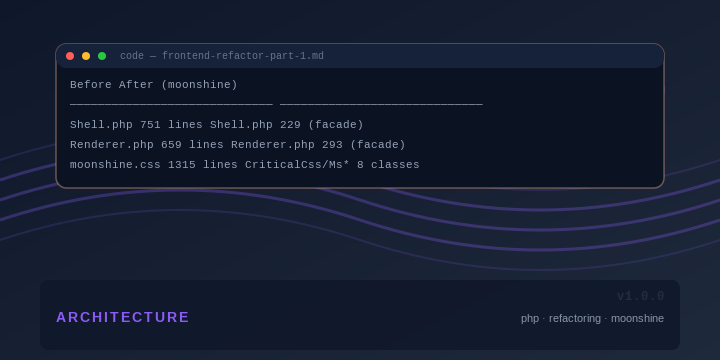
not a machine's. Shell.php had 751 lines, Renderer.php 659, moonshine.css 1315. Editing one thing meant scrolling through 1300 lines.
That is exactly why the refactor didn't stop at moving code around, the threshold becomes an architecture test that fails if any theme file ever grows back past 600 lines. More on that in part 3.
2. The map, before and after
Before                            After (moonshine)
─────────────────────────────     ─────────────────────────────
Shell.php            751 lines    Shell.php            229 (facade)
Renderer.php         659 lines    Renderer.php         293 (facade)
moonshine.css       1315 lines    CriticalCss/Ms*    8 classes
                                  Chrome/{Nav,Controls,Scripts}
                                  Sections/{Support,Cards,
                                            Widgets,Article,
                                            Hero,BlogIndex}
The deal: no method changed, none disappeared, nothing was merged.
Addresses changed, not behavior.
3. Three kinds of sections
CriticalCss/Ms\*, eight classes (MsTokens, MsSidebar, MsTopbar, MsMobile, MsContent, MsWidgets, MsArticle, MsToc), each with a single render(): string method holding a heredoc moved word for word from the original criticalCssMs*() helpers. The Shell::criticalCss() facade chains them in the exact original order.
Chrome/: shell furniture: Nav (sidebar navigation, burger, collapse), Controls (theme toggle, locale switcher, chromeLabels(), deferred CSS) and Scripts (theme init, drawer, back-to-top).
Sections/: the renderer's body: Support (shared vocabulary:t(), dates, hrefs, wrappers), Cards, Widgets, Article, Hero, BlogIndex. Renderer.php stays a facade, each of the ~20 public static methods is an explicit one-line delegate. No __call: that's a C-pattern ban, transparency over shortcuts.
4. Byte-parity: the trap waiting in heredocs
The series has one simple invariant: **critical CSS must come out byte-identical**. Snapshot before the move:
php -r 'require "src/init.php";
file_put_contents("/tmp/ms-critical-before.txt",
  Themes\moonshine\Shell::criticalCss());'
# 41,140 bytes
After the move, compare, and the first run reported a difference.
The cause is subtle and classic PHP heredoc behavior: **the heredoc closing marker eats the trailing newline**. The original chain of eight heredocs therefore had spots with zero newlines between parts (and one spot, tokens→sidebar, with one, they shared a heredoc).
The new classes each wrote their own spacing, and the mismatch was baked in.
The second trap was in my own extraction script: rindex("/**") grabbed one docblock too early, because one of the original methods had no docblock. Python silently cut it, PHP silently swallowed it, and the snapshot caught it within seconds.
That is precisely why the parity drill is not a formality:
php -r 'require "src/init.php";
echo Themes\moonshine\Shell::criticalCss()
  === file_get_contents("/tmp/ms-critical-before.txt")
  ? "BYTE-PARITY OK" : "MISMATCH";'
# BYTE-PARITY OK (41,140 bytes)
5. PHP 8.5: when a class name collides with an import
The most interesting error arrived from PHPStan, which loads every file through its bootstrap. Sections/Article.php declared a class Article and also did use Modules\Blog\Domain\Entities\Article;, under the same short name. PHP 8.5 fatals on that:
Fatal error: Cannot redeclare class Themes\moonshine\Sections\Article
(previously declared as local import)
The interesting part: PHPUnit swallowed it (it only loads the classes it needs); PHPStan's full load exposed it. Lesson: name sections after the job, not the entity, the magazine theme's article section is therefore called ArticleView.
6. Mirror: magazine and CSS with its own boundaries
The pattern moved to the magazine theme (Shell 752 → 196, Renderer 576 → 249). Something new appeared there, splitting CSS.magazine.css (423 lines) already had its own section comments (── Header ──, ── Cards ──…), so the files src/magazine/{index,tokens,shell,content,article,utilities}.css were cut along the original boundaries, and index.css is an ordered @import chain, because import order IS the cascade.
The invariant is hardware-grade there too:
cmp public/dist/starter/assets/magazine-CeqghFH8.css /tmp/mag-built-before.css
# identical — same content hash even after a rebuild
The same hash CeqghFH8 means Vite saw exactly the same rules in exactly the same order. And AssetManager: manifest keys, hashed names, didn't change at all.
7. What you take away
- Sections along real seams, not a paper plan. The plan assumed
Sections/Home.php: reality: home/taxonomy markup lives in the action classes, the theme only renders building blocks. Fake sections would have been a new kind of chaos.
- A facade without magic is cheap and readable. 20 delegates,
one line each.
- Parity is proven with snapshots, not conviction. Heredoc
newlines, missing docblocks and same-named imports, all of it is silent until you make it loud.
In the next part: the minimal theme, the ThemeFileSizeTest regression guard (the 600-line ceiling enforced by an architecture test), and the docs.
→ How MoonShine Inspired Cardboard, where the themes' token and component language comes from → Theme Architecture: why themes have a Shell/Renderer/Manifest at all
Sources
- WCAG 2.2, Contrast (Minimum): the contract
BuildCssAuditTestcomputes from shipped tokens openspec/changes/2026-09-13-theme-section-split/: the plan for the
whole series
src/Themes/moonshine/: the resulting structure (CriticalCss/, Chrome/,
Sections/)
tests/Css/BuildCssAuditTest.php: the WCAG contracts that stayed green
against the byte-identical bundle
Comments (0)
No comments yet — be the first to react.