
 · Nativa Dev
In part 12 we moved identities into the things themselves. Today a thing that had been silent for years spoke up: an article pinning its cover to an imgur URL. The browser refused it. Nobody found out.
What happened
The article template knows an image: line, a pin to one specific cover. One older article carried i.imgur.com/placeholder.png. A literal placeholder. The browser will never show it: CSP allows images only from our own server and from cloudinary. Imgur dies at the door.
And more: the failure was silent. No error in the log, no alert. The page looks healthy, until someone looks exactly where the image should be. The most expensive failures are the ones that never announce themselves.
The ladder that should have been there
A pin isn't the only way an article gets its cover. resolveCover() walks a ladder: the explicit pin first, then the local SVG with its ?v= hash, and the cloudinary pool as a safety net at the bottom.
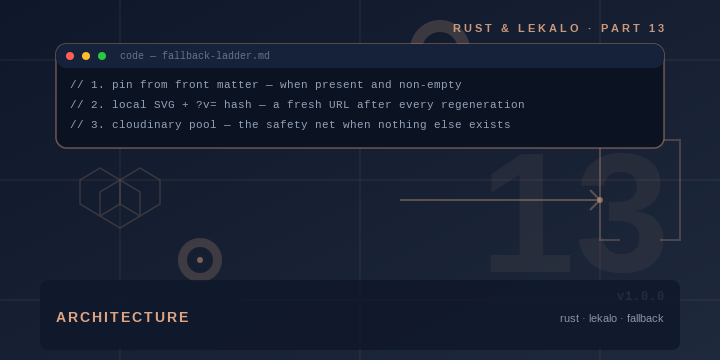
A fallback ladder, the order that says who steps in when the previous step falls:
// 1. pin from front matter — when present and non-empty
// 2. local SVG + ?v= hash — a fresh URL after every regeneration
// 3. cloudinary pool — the safety net when nothing else exists
Every system that tries something and doesn't plan for the first attempt to fall has a ladder, written down, or hidden in the code.
The question isn't whether a ladder exists. The question is whether you can say who steps in, and why. We could. We also knew what the ladder didn't know: how a pin fails when the browser refuses it.
It fails silently, and silence is a hole in the ladder.
The contract gives the failure a name
The fix isn't to change the CSP or the ladder. The fix is to give the silent failure a voice, a contract that catches a broken pin before it leaves the building. CoverPinPolicyTest runs over every article and checks two rules:
// 1. the pin must be renderable (CSP allowlist)
$allowed = '/' === $host
    || in_array($host, self::CSP_ALLOWED_HTTPS_HOSTS, true);

// 2. the pin must not point at generator output
//    — the ladder versions that URL through ?v=
self::assertFalse(
    str_starts_with($pin, '/storage/blog-images/'),
    'pinning your own SVG bypasses cache-busting',
);
The first rule: an imgur pin dies in the test, not in a reader's browser. The second: nobody pins their own SVG, that would bypass the ?v= hash and a regeneration would serve year-old bytes again, the case from part 12. A failure with a name can be fixed. A failure without one can only be found, if someone looks.
Why the CSP isn't enough
Why a contract when the CSP decides anyway? Because the CSP is the last rung of the ladder, it stops a bad URL but says nothing. The message arrives in the reader's browser, and only as an image that isn't there. Rust has the same instinct: Result<T, E> won't let a failure pass without a name, the language requires you to type the error. Our silent image was a fall without a type. The CSP is a sound policy, not a report. The report has to come earlier, where you write, not where you read.
A ladder is order, not an argument. Whoever has a place in the order steps in, and a failure that announces itself is part of the order.
Cloudinary in the ladder
Cloudinary stays excellent, just not as an article's identity. The pool holds the mood and handles a genuinely unique image for an article that earns one. Which is exactly why it isn't the place for a deterministic cover that must survive regeneration unchanged. The pool decides by chance, the ladder by order, and identity is order.
A human note
A ladder doesn't make a system indestructible. It guarantees one thing:
when the first step falls, the next steps in by order, and the failure announces itself by name, not by silence. The next person who comes after you sees the ladder and understands the order. And the reader sees the image, because the failure that never announced itself, this time, wasn't there.
→ Part 12, covers as contracts: the identity of a thing lives in the thing; regeneration changes the URL → Part 11, the map says 393, the terrain 962, what an agent may trust when it reads a map → MDN: Content-Security-Policy img-src, the browser as the last rung of the ladder
Sources
tests/Unit/CoverPinPolicyTest.php: the contract: CSP renderability- no pinning your own SVG
src/Modules/Blog/Application/Services/BlogArticlesService.php,
the resolveCover() ladder: pin → local SVG with ?v= → cloudinary pool
src/Modules/Core/Interfaces/HTTP/Middleware/SecurityHeadersMiddleware.php,
the CSP img-src allowlist
Comments (0)
No comments yet — be the first to react.