
 · Nativa Dev
In the previous article we wrote about the philosophy of evolving DI patterns from Thesis DIC for Nativa Minimal. Now we've implemented it.
Three files. Zero dependencies. No container.
What we implemented
Three new building blocks:
| File | Purpose |
|---|---|
#[AsMiddleware] | Attribute for auto-discovery |
MiddlewareRegistry | Auto-discovery of #[AsMiddleware] classes |
ModuleInterface | Lightweight contract for modules |
DisposalRegistry | Cleanup callbacks (best-effort) |
1. #[AsMiddleware] ... the attribute
Exactly like #[AsMigrator] we already have:
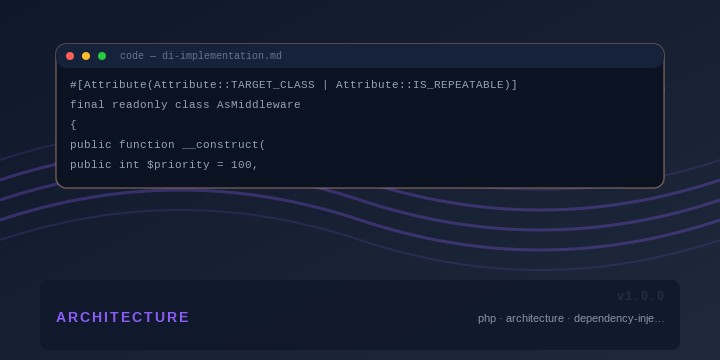
#[Attribute(Attribute::TARGET_CLASS | Attribute::IS_REPEATABLE)]
final readonly class AsMiddleware
{
    public function __construct(
        public int $priority = 100,
    ) {}
}
Usage:
#[AsMiddleware(priority: 0)]   // first in pipeline
final readonly class SecurityHeadersMiddleware implements MiddlewareInterface
{
    // ...
}

#[AsMiddleware(priority: 20)]
final class CsrfMiddleware implements MiddlewareInterface
{
    // ...
}

#[AsMiddleware(priority: 999)] // last in pipeline
final readonly class DebugbarMiddleware implements MiddlewareInterface
{
    // ...
}
Priority: lower number = earlier in pipeline. Security headers are first, debugbar is last.
2. MiddlewareRegistry ... auto-discovery
Exactly like ThemeRegistry ... scans files and discovers classes:
final class MiddlewareRegistry
{
    public static function all(): array
    {
        // Scan src/Modules/*/Interfaces/HTTP/Middleware/
        $dirs = glob($base . '/*/Interfaces/HTTP/Middleware');

        foreach ($dirs as $dir) {
            $files = glob($dir . '/*.php');
            foreach ($files as $file) {
                // Check for #[AsMiddleware] attribute
                // Instantiate if no required constructor args
            }
        }

        // Sort by priority
        uasort($middlewares, fn($a, $b) => $a[0] <=> $b[0]);

        return $middlewares;
    }
}
Test:
$middlewares = MiddlewareRegistry::all();
// Returns: [SecurityHeaders(0), Csrf(20), Debugbar(999)]
Auto-discovered: 3 middleware (no required constructor args).
Manually added: 3 middleware (with required constructor args):
RateLimitMiddleware... needsClosure: RateLimiterAuthMiddleware... needsClosure: AuthServiceLocaleMiddleware... needsLocaleService
3. ModuleInterface ... lightweight contract
Thesis has Module<T>. We have ModuleInterface:
interface ModuleInterface
{
    /** Unique module identifier */
    public function name(): string;

    /** Register middleware, routes, services */
    public function register(Kernel $kernel): void;

    /** Module-specific migrations */
    public function migrations(): array;
}
Example:
final class UsersModule implements ModuleInterface
{
    public function name(): string
    {
        return 'users';
    }

    public function register(Kernel $kernel): void
    {
        $kernel->addMiddleware(new AuthMiddleware(
            fn() => CardboardServices::auth(),
        ));
    }

    public function migrations(): array
    {
        return [CreateUsersTable::class];
    }
}
Benefits:
- Standardization ... every module has the same contract
- Testability ... easy to test register() and migrations()
- Auto-discovery ready ... scan for ModuleInterface implementations
4. DisposalRegistry ... cleanup callbacks
Thesis has disposer(). We have DisposalRegistry:
final class DisposalRegistry
{
    public static function register(string $id, callable $disposer): void
    {
        self::$disposers[$id] = $disposer;
    }

    public static function disposeAll(?\Throwable $error = null): void
    {
        foreach (self::$disposers as $id => $disposer) {
            try {
                $disposer($error);
            } catch (\Throwable $e) {
                error_log("[DISPOSAL] {$id}: {$e->getMessage()}");
            }
        }
        self::$disposers = [];
    }
}
Usage:
// Register cleanup
DisposalRegistry::register('db', fn() => $pdo->close());
DisposalRegistry::register('cache', fn() => $cache->flush());

// At end of request
DisposalRegistry::disposeAll();

// On error
try {
    $kernel->handle($request);
} catch (\Throwable $e) {
    DisposalRegistry::disposeAll($e);
}
Best-effort: All disposers run even if one throws.
Errors are logged but not rethrown.
5. UnitOfWork ... transactional consistency
Thesis doesn't have UnitOfWork ... but we do. Simple and effective:
final class UnitOfWork
{
    public function transaction(callable $fn): mixed
    {
        $this->pdo->beginTransaction();
        try {
            $result = $fn($this->pdo);
            $this->pdo->commit();
            return $result;
        } catch (\Throwable $e) {
            $this->pdo->rollBack();
            throw $e;
        }
    }
}
Repository integration:
// Before ... 5 separate DELETEs
public function delete(string $id): void
{
    $this->pdo->prepare('DELETE FROM user_roles ...')->execute([...]);
    $this->pdo->prepare('DELETE FROM password_reset_tokens ...')->execute([...]);
    $this->pdo->prepare('DELETE FROM remember_tokens ...')->execute([...]);
    $this->pdo->prepare('DELETE FROM sessions ...')->execute([...]);
    $this->pdo->prepare('DELETE FROM users ...')->execute([...]);
    // If one fails ... orphan data!
}

// After ... all in one transaction
public function delete(string $id): void
{
    $uow = new UnitOfWork($this->pdo);
    $uow->transaction(function (\PDO $pdo) use ($id): void {
        $pdo->prepare('DELETE FROM user_roles ...')->execute([...]);
        $pdo->prepare('DELETE FROM password_reset_tokens ...')->execute([...]);
        $pdo->prepare('DELETE FROM remember_tokens ...')->execute([...]);
        $pdo->prepare('DELETE FROM sessions ...')->execute([...]);
        $pdo->prepare('DELETE FROM users ...')->execute([...]);
    });
}
Integrated in:
UserRepository::delete()... 5 DELETEs atomicRoleRepository::deleteRole()... 3 DELETEs atomicRoleRepository::syncPermissions()... diff + apply atomic
6. syncPermissions ... diff + apply
Instead of manual foreach over current/wanted:
// Before ... non-atomic diff
foreach ($current as $pid) {
    if (!in_array($pid, $wanted, true)) {
        $roles->removePermission($id, $pid);
    }
}
foreach ($wanted as $pid) {
    if (!in_array($pid, $current, true)) {
        $roles->assignPermission($id, $pid);
    }
}

// After ... atomic sync
$roles->syncPermissions($id, $wanted);
How it fits the existing stack
Before implementation
Middleware: manual registration in public/index.php
Migrators: #[AsMigrator] + auto-discovery
Themes: ThemeRegistry + auto-discovery
Module: implicit (namespace-based)
Disposal: none
UnitOfWork: none
After implementation
Middleware: #[AsMiddleware] + MiddlewareRegistry (auto-discovery)
Migrators: #[AsMigrator] + DatabaseMigrator (auto-discovery)
Themes: ThemeRegistry + auto-discovery
Module: ModuleInterface (formal contract)
Disposal: DisposalRegistry (cleanup callbacks)
UnitOfWork: transactional consistency (user/role deletes, permission sync)
Tests: 443 tests, 1343 assertions
Kernel integration
// Kernel constructor - auto-discovers #[AsMiddleware]
public function __construct(
    private readonly Router $router,
    bool $autoDiscoverMiddleware = true,
) {
    if ($autoDiscoverMiddleware) {
        foreach (MiddlewareRegistry::all() as $middleware) {
            $this->middleware[] = $middleware;
        }
    } else {
        $this->middleware[] = new SecurityHeadersMiddleware();
    }
}
Request lifecycle integration
// public/index.php - at end of request
$response->send();
DisposalRegistry::disposeAll();
Philosophy
Learning from Thesis, implementing simply. No dependencies, just patterns.
Thesis DIC is a great container. We don't need it.
But its patterns are universal:
| Pattern | Thesis | Nativa |
|---|---|---|
| Tags | Tag<T> + taggedList() | ThemeRegistry + MiddlewareRegistry |
| Module | Module<T> interface | ModuleInterface (lightweight) |
| Autoconfiguration | onObject() callback | #[As*] attributes + discovery |
| Disposal | disposer() callback | DisposalRegistry |
Key insight: We don't need a container that controls everything.
We need patterns that work without a container.
Next steps
| Phase | What | Status |
|---|---|---|
| 1 | #[AsMiddleware] + MiddlewareRegistry | Done + tests |
| 2 | ModuleInterface | Done |
| 3 | DisposalRegistry | Done + tests |
| 4 | UnitOfWork + syncPermissions | Done + tests |
| 5 | #[As*] attributes (commands, events) | Proposed |
| 6 | RequestScope ... explicit scoping | Proposed |
The patterns remain lightweight, not because we're against containers, but because the starter kit doesn't need one.
A container that controls everything controls nothing. Patterns that work without a container work everywhere.
→ DI Evolution: the philosophy behind the patterns → Theme Architecture: auto-discovery in practice
Sources
- PHP-FIG, PSR-15 HTTP Server Request Handlers: standardized middleware interface
- PHP Manual, SPLAutoLoader: PSR-4 autoloading
- PHPUnit, Test Isolation: disposal and test cleanup patterns
- PHPStan, Rule Customization: static analysis for module boundaries
- Nativa Minimal, Adding Modules: official guide for adding modules
Comments (0)
No comments yet — be the first to react.