
 · Nativa Dev
Thesis DIC is a small, opinionated dependency injection container for PHP 8.4.
We have Nativa Minimal ... a zero-dependency runtime without any framework.
And yet, there's something to learn from Thesis and evolve into our stack.
The current Nativa pattern
Our services use "lazy cached service factories":
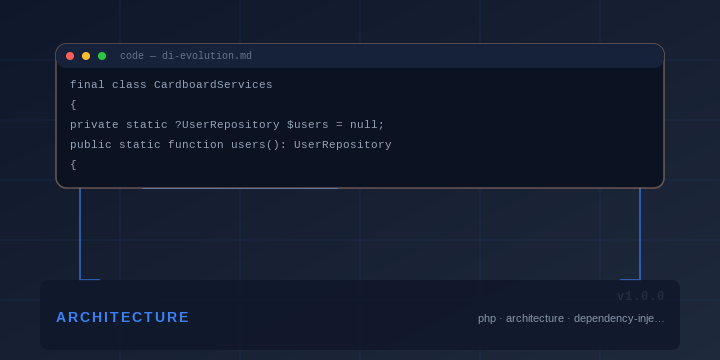
final class CardboardServices
{
    private static ?UserRepository $users = null;

    public static function users(): UserRepository
    {
        return self::$users ??= new UserRepository(
            DatabaseConnectionManager::instance()->connection('users'),
        );
    }
}
Pros:
- Zero dependencies
- Lazy loading (??=)
- Test isolation (reset())
Cons:
- Manual registration
- No auto-discovery
- No tags
- No formalized module contract
What Thesis DIC teaches us
Thesis has three key concepts:
1. Tags ... grouping services
// Thesis
$dic->object(RedisCache::class)->tag(new CacheTag());
$dic->object(ApcuCache::class)->tag(new CacheTag());
$caches = $dic->taggedList(CacheTag::class); // Ref<list<Cache>>
2. Module ... formal contract
// Thesis
interface Module<T>
{
    public function configure(Dic $dic): mixed;
}
3. Autoconfiguration ... convention over configuration
// Thesis
$dic->onObject(static function (ObjectAutoconfig $object): void {
    if ($object->attributes->has(AsCommand::class)) {
        $object->tag(new CommandTag());
    }
});
Evolution for Nativa
1. Tags → Theme Registry (ALREADY DONE)
We just built ThemeRegistry ... exactly the Thesis tag pattern:
// Nativa
final class ThemeRegistry
{
    public static function all(): array
    {
        // auto-discovery via glob
        $manifestFiles = glob($base . '/*/Manifest.php');
        // ...
    }
}
Generalization: This pattern can be used for middleware, commands, migrations.
2. Module Interface → Lightweight Contract
Thesis has Module<T>. Nativa has implicit modules.
Proposed interface:
interface Module
{
    /** Unique module identifier */
    public function name(): string;

    /** Register middleware, routes, services */
    public function register(Kernel $kernel): void;

    /** Module-specific migrations */
    public function migrations(): array;
}
Implementation example:
final class UsersModule implements Module
{
    public function name(): string
    {
        return 'users';
    }

    public function register(Kernel $kernel): void
    {
        $kernel->addMiddleware(new AuthMiddleware());
    }

    public function migrations(): array
    {
        return [
            CreateUsersTable::class,
            CreateRolesTable::class,
        ];
    }
}
Benefit: Standardization, auto-discovery, testability.
3. Attribute-based Registration
Thesis has onObject() / onFunction(). Nativa has #[Route].
Evolution ... more attributes:
// Already have
#[Route(path: '/blog', method: 'GET')]
class BlogIndexAction { }

// Could add
#[AsMiddleware(priority: 10)]
class SessionMiddleware implements MiddlewareInterface { }

#[AsCommand(name: 'migrate')]
class MigrateCommand { }

#[AsMigrator(module: 'users', table: 'users')]
class CreateUsersTable implements MigratorInterface { }
Auto-discovery:
final class AttributeRegistry
{
    public static function discover(string $attribute): array
    {
        // Scan src/Modules/*/ for classes with $attribute
        // Return instances
    }
}
4. Disposal ... Cleanup Callbacks
Thesis has disposer(). Nativa doesn't.
Proposed:
final class DisposalRegistry
{
    private static array $disposers = [];

    public static function register(string $id, callable $disposer): void
    {
        self::$disposers[$id] = $disposer;
    }

    public static function disposeAll(?Throwable $error = null): void
    {
        foreach (self::$disposers as $id => $disposer) {
            try {
                $disposer($error);
            } catch (\Throwable $e) {
                error_log("[DISPOSAL] {$id}: {$e->getMessage()}");
            }
        }
        self::$disposers = [];
    }
}
Usage:
// At end of request
DisposalRegistry::disposeAll();

// Or on error
try {
    $kernel->handle($request);
} catch (\Throwable $e) {
    DisposalRegistry::disposeAll($e);
}
5. Scoped Lifetimes ... Explicit Request Scoping
Thesis has defaultScoped(). Nativa has implicit.
Proposed:
final class RequestScope
{
    private static array $services = [];

    public static function get(string $id): mixed
    {
        return self::$services[$id] ?? null;
    }

    public static function set(string $id, mixed $service): void
    {
        self::$services[$id] = $service;
    }

    public static function run(callable $fn): mixed
    {
        self::$services = [];
        try {
            return $fn();
        } finally {
            self::$services = [];
        }
    }
}
Philosophy: fewer dependencies, more patterns
Thesis DIC is a great container. We don't need it.
But its patterns are universal:
| Pattern | Thesis | Nativa (proposed) |
|---|---|---|
| Tags | Tag<T> + taggedList() | ThemeRegistry + MiddlewareRegistry |
| Module | Module<T> interface | Module interface (lightweight) |
| Autoconfiguration | onObject() callback | #[As*] attributes + discovery |
| Disposal | disposer() callback | DisposalRegistry |
| Scoped | defaultScoped() | RequestScope |
Key insight: We don't need a container that controls everything.
We need patterns that work without a container.
Roadmap
| Phase | What | Why |
|---|---|---|
| 1 | TagRegistry ... generalize ThemeRegistry | Middleware, commands, migrations |
| 2 | Module interface | Standardize modules |
| 3 | #[As*] attributes | Auto-discovery, less boilerplate |
| 4 | DisposalRegistry | Cleanup, test isolation |
| 5 | RequestScope | Explicit scoping |
Summary
- Thesis DIC teaches us patterns, not dependencies
- ThemeRegistry is already the Thesis tag pattern in Nativa style
- Module interface standardizes how modules register
- Attributes reduce boilerplate
- Disposal and scoping improve test isolation
- All without adding a single dependency
That's the Nativa philosophy: learn from the best, implement simply.
→ Theme Architecture: auto-discovery in practice → Theme Comparison: three themes, one pattern
Sources
- Thesis DIC Documentation: official Thesis dependency injection container documentation
- PHP-FIG, PSR-11 Container Interface: standardized container interface
- PHP Manual, Attributes: PHP 8 native attributes
- Martin Fowler, Inversion of Control: classic article on IoC and DI patterns
- PHPStan, Extension Points: static analysis for DI patterns
Comments (0)
No comments yet — be the first to react.