
 · Nativa Dev
In part 11 the map was stale and the terrain was true. The same week continues: a series of eleven parts stood in front of us, wanting to look like a series, and the tool deciding that had no idea it existed.
What happened
The blog covers come from a CLI. It has switches: template, color. In the morning a regeneration of everything ran, and the switches fell back to their defaults. The series' rust template (hexagons, orange) was wiped to blue code. Nobody wanted that; the tool had no way of knowing those twenty articles belonged together. The only truth about the series' identity lived in the hands of whoever was typing the command.
That is not a one-run bug. It is a missing contract.
The four rules of the new generator
The generator was rewritten. Not for prettier hexagons, for four rules that make it a tool you can trust. The solution did not start with code, but with a question: where should each truth live?
One: same article, same bytes. No timestamps, sorted listings, positional rules instead of a "random line". Two runs must produce an identical file. Verified by md5.
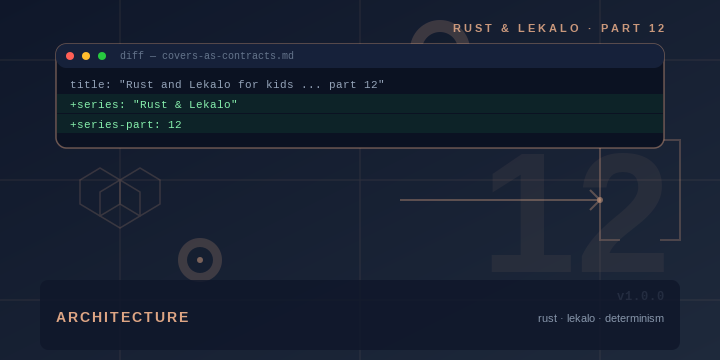
Two: a series' identity is a property of the article. Two front matter lines and the tool knows what to do even without switches:
 title: "Rust and Lekalo for kids ... part 12"
+series: "Rust & Lekalo"
+series-part: 12
The series identity hashes to one template-color pair shared by every member. The CLI switches remain only as an override, "regenerate all" can no longer wipe anything, because the default is read from the article, not from the operator's hands.
Three: the cover is evidence. The cover carries a terminal window with a snippet from the article, chained as cover-code: → first diff block → first code block. And a contract test that runs over every published article, checking the lines on the cover are literally in the article. Cover code cannot be decoration; it is a quote with a known source.
Four: regeneration changes the URL. Covers ship with a year-long Cache-Control: immutable: and we just experienced a browser serving a year-old truth after regeneration. A local cover now carries a ?v= hash of its content: new bytes, new address.
Why this is not cosmetics
Part 11 ended with a question: what may an agent trust when it reads a map? The answer was: contracts, things something checks. The generator is a small specimen of a large principle: **a property of a thing belongs to the thing, not to the operator's hands.** Rust has the same instinct elsewhere, nothing is carried in the compiler's "head"; types, trait bounds and doc-tests live where the code lives, and the machine checks them on every run. A contract nobody checks is decoration. A contract something checks is a map that ages together with the terrain.
And the terrain checked in immediately. The number 964, which part 11 had just written into the map that morning, was stale by noon: the suite gained the generator's contract tests and the map says 1353 tests. The pattern from part 11 repeated live, a number in documentation is a claim with an expiry date, and the only thing keeping it true is running the gates. Real-time proof:
before this text shipped, 1353 went stale too, the series articles brought six more tests and the map says 1359.
A human note
When things belong together, do not write it into a command. Write it where the thing lives, so whoever comes after you reads it, and the machine checks it for you. The CLI override remains a great tool, just not for identities that must outlive a single run. An identity held only in the memory of one run is not an identity. It is an accident that has not yet repeated itself.
→ Part 11, the map says 393, the terrain 962, on numbers with an expiry date → Rust documentation tests, documentation checked by a machine
Sources
src/Modules/Blog/Application/Services/CoverGenerator.php: rules 1–4 in codetests/Unit/CoverCodeIsFromArticleTest.php+tests/Unit/CoverDeterminismTest.php,
the contracts (snippet provenance, byte determinism, cache-buster)
docs/blog-covers.md: generator documentation- Part 11, the map says 393, the terrain 962
- Rust documentation tests
Comments (0)
No comments yet — be the first to react.