
 · Nativa Dev
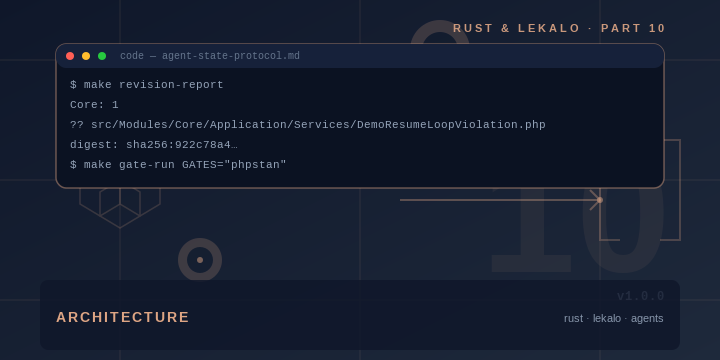
In part 9.2 themes got their routes in the model. Today nothing is added to the model, today something rarer happens: an idea from a note became a tool. The original text promised a revision hash would cut agent iterations from eleven to four.
The numbers were invented. The idea was not.
What happened
An agent returning to a task spends its first iteration on a question:
what changed? A gate fails, and the next iteration spends itself on the second question: where? Both answers exist deterministically. The agent just had to re-derive them every time.
Three tools emerged (no new hashing code, no edge graph):
| Tool | What it does |
|---|---|
bin/revision-report.php | groups git status changes into modules + digest |
bin/gate-run.php | runs a gate, records failures (exit + digest + tail) |
make revision-report | both on one command, --json for machines |
The report header carries a simple contract: *informational, quality gates always run in full*. A failure record is a reading aid, not a replacement for verification.
What was not built
The original plan had openspec-hash.php and edge-diff.php. Rejected deliberately:
- git already knows the tree state: content-based, immune to
mtimes; a second hash would only risk disagreeing with git's view,
lekalo.lockis already the contract hash: copying it into
another file means two truths instead of one,
- edges need a graph: a PHP monolith has none; inventing one for a
report is a mini-Bazel.
Exactly the fifth agreement: solve architecture at one hundred percent, or not at all. One hundred percent here meant less code, not more.
The revision report stays great at sizing a change, just not at deciding what is correct. Deciding belongs to tests and to people.
A live run: four breaths
The day after deployment came the first real test: a file deliberately dropped into src/ that PHPStan level 9 refuses.
$ make revision-report
Core: 1
  ?? src/Modules/Core/Application/Services/DemoResumeLoopViolation.php
digest: sha256:922c78a4…

$ make gate-run GATES="phpstan"
FAIL (exit 1) — recorded; resume: php bin/gate-run.php --output phpstan

$ php bin/gate-run.php --output phpstan
== recorded failure: phpstan (exit 1) ==
Line   src/Modules/Core/Application/Services/DemoResumeLoopViolation.php
...    Method broken() has parameter $noType with no value type specified.

$ rm src/Modules/Core/Application/Services/DemoResumeLoopViolation.php
$ make gate-run GATES="phpstan"
OK (1.0s)

$ php bin/revision-report.php
(no failed-gates section — the record cleared itself)
Four steps: report, failure, reading the tail, fix. No guessing, no re-running whole gates. And notice the last step, the record deletes itself when the gate passes. A tool that cleans up after itself.
Why it works
Because the state is deterministic. Same tree → same report → same digest. Docker or CI resets mtimes? The report does not move. A HashMap changes order? Sort before hashing. A gate fails on output with timing in it? The digest identifies the exact recorded output, the latest record wins, a pass clears it.
The agent's step number one stopped being a guess and became a read.
The whole trick rests on determinism, exactly how [Cargo's build cache](https://doc.rust-lang.org/cargo/reference/build-cache.html) works: do not rebuild what is fresh.
Does the record replace the gate?
Never. make pre-commit always runs in full, lint, analysis, tests, lekalo. A failure record is a margin note, not a decision. When the report says "phpstan failed", the agent reads the tail and fixes; when it says "clean", the agent runs pre-commit as always. The difference between an AI agent and an AI agent with a contract is not intelligence, it is what it is allowed to remember and what it is allowed to trust.
→ Part 9, themes get routes, bindings, scenarios and the grammar limit → Cargo build caching, the fingerprint mechanics the idea came from
Sources
bin/revision-report.php+bin/gate-run.php: agent-state tooling
(zero-dep, outside phpstan paths, following the audit-rhythm.php precedent)
bindings, scenarios and the grammar limit
the fingerprint mechanics the idea came from
Comments (0)
No comments yet — be the first to react.